

Full Stack Learning Path Simulator
Select technologies to see how they fit into a standard Full Stack roadmap. Compare their difficulty and market demand.
Select at least one technology on the left to begin your analysis.
You don't need to learn C++ to become a full stack developer. In fact, most job postings for this role in 2026 list JavaScript, TypeScript, Python, or Java as the primary requirements. If you are staring at a curriculum that starts with pointers and memory management, take a breath. That path is likely optimized for systems programming, not for building the websites and apps users actually interact with daily.
The confusion usually stems from the word "stack." People hear "full stack" and think it means knowing every language ever created. It doesn't. It means understanding how data moves from a browser (frontend) to a server (backend) and back again. While C++ powers the engines under the hood of many major platforms, it rarely touches the code you will write as a full stack engineer.
What a Full Stack Developer Actually Does
To understand why C++ isn't on the mandatory list, we have to look at the daily tasks of the role. A full stack developer builds user interfaces using HTML, CSS, and JavaScript frameworks like React or Vue.js. Then, they build the logic that processes requests, often using Node.js, Python, or PHP. Finally, they manage databases like PostgreSQL or MongoDB.
Think of it like running a restaurant. The frontend is the dining room where customers see the menu and place orders. The backend is the kitchen where the food is prepared. The database is the pantry where ingredients are stored. C++ is the steel structure of the building itself. You need the building to stand, but unless you are an architect or structural engineer, you don't spend your day welding beams. You spend your time plating dishes and serving guests.
Where C++ Actually Fits in Tech
C++ is a powerhouse, but its domain is specific. It excels in performance-critical environments where every millisecond counts. This includes game engines like Unreal Engine, operating system kernels, and high-frequency trading platforms. Even in the web world, C++ appears in the infrastructure layer. For example, the V8 engine that runs JavaScript in Chrome is written in C++. However, you interact with V8 through JavaScript, not by writing C++ code directly.
If you work at a company like Netflix or Amazon, you might see C++ used in their recommendation algorithms or video compression pipelines. But those are specialized teams. The team building the user profile page? They are using JavaScript or TypeScript. The team handling user authentication? They are likely using Go, Java, or Python. C++ is the heavy artillery, not the everyday rifle.
The Languages You Should Learn Instead
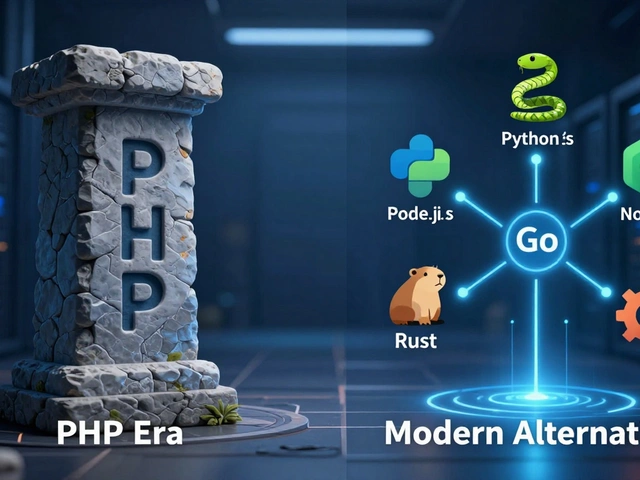
Instead of spending months on C++ syntax, focus on the languages that dominate the current job market. Here is a realistic breakdown of what you need:
- JavaScript & TypeScript: The universal language of the web. You cannot escape it. Learn ES6+ features and TypeScript for type safety.
- A Backend Language: Pick one. Node.js (using JavaScript), Python (Django/FastAPI), or Java (Spring Boot). These cover 90% of commercial projects.
- SQL: You need to query relational databases. PostgreSQL is the industry standard.
- Git: Version control is non-negotiable for any professional workflow.
Notice that C++ is absent from this list. This is intentional. Learning too many languages at once leads to shallow knowledge. It is better to be proficient in three core technologies than mediocre in ten.
| Technology | Primary Use Case | Learning Curve | Job Market Demand (2026) |
|---|---|---|---|
| JavaScript/TypeScript | Frontend & Backend (Node.js) | Moderate | Very High |
| Python | Backend, Data Science, AI | Low | High |
| Java | Enterprise Backend, Android | Moderate-High | High |
| C++ | Systems Programming, Game Dev, Embedded | Steep | Niche/Specialized |

When Might You Actually Need C++?
There are rare scenarios where a full stack developer might benefit from C++ knowledge. If you are building a real-time collaborative tool that requires extreme low latency, you might write a microservice in C++ or Rust to handle the heavy lifting. Or, if you are moving into game development, C++ becomes essential. But these are career pivots, not standard full stack requirements.
Another angle is performance optimization. If you are working on a massive scale platform and find that your JavaScript backend is hitting CPU limits, you might offload specific tasks to a C++ extension. But this is an advanced optimization step, usually done after the application is already live and proven. It is not something you do during the initial build phase.
Also, consider the ecosystem. The npm package registry has over two million packages. Most are written in JavaScript or TypeScript. The PyPI repository has hundreds of thousands of Python packages. Finding pre-built solutions in C++ for web-specific problems is much harder. You would be reinventing wheels that others have already built in higher-level languages.
The Risk of Learning C++ Too Early
Here is the trap: C++ is difficult. It forces you to manage memory manually. It has complex compilation steps. It can be frustrating for beginners. If you start your journey here, you risk burnout before you even build your first "Hello World" website. The goal of learning to code is to build things. C++ slows down the feedback loop. You want to see results quickly to stay motivated. JavaScript lets you do that in minutes. C++ can take hours just to set up the environment correctly.
Furthermore, the concepts you learn in C++ (like manual memory management) are less relevant in modern full stack development. Garbage collection in Java, Python, and JavaScript handles memory for you. Focus on architectural patterns, API design, and state management instead. These skills transfer across languages. Knowing how to point to a memory address does not help you design a scalable REST API.

How to Structure Your Learning Path
If you are starting out in 2026, follow this streamlined path to maximize your employability:
- Master the Web Basics: HTML5, CSS3, and vanilla JavaScript. Build static sites. Understand the DOM.
- Learn a Framework: Choose React or Vue.js. Build dynamic single-page applications.
- Pick a Backend Stack: Start with Node.js since you already know JavaScript. Learn Express.js or Fastify.
- Add a Database: Learn SQL basics and connect to PostgreSQL. Understand relationships and indexing.
- Deploy: Learn Git, GitHub, and basic cloud deployment (AWS or Vercel).
Only after you are comfortable with this stack should you consider exploring other languages. At that point, you can decide if you want to dive into C++ for a specific interest, like graphics programming or embedded systems. But for getting hired as a full stack developer, the above path is sufficient and highly effective.
Frequently Asked Questions
Can I get a job as a full stack developer without knowing C++?
Yes, absolutely. Over 95% of full stack developer job listings do not require C++. They prioritize JavaScript, TypeScript, Python, or Java. Your portfolio and problem-solving skills matter far more than knowing a niche systems language.
Is C++ harder to learn than JavaScript?
Generally, yes. C++ has a steeper learning curve due to manual memory management, complex syntax, and longer compile times. JavaScript is interpreted and has a more forgiving runtime, making it faster to learn for web development purposes.
Does C++ run faster than JavaScript?
In raw computational speed, C++ is significantly faster because it compiles to machine code. However, for typical web applications, the difference is negligible. The bottleneck is usually network latency or database queries, not the speed of the code execution itself.
Should I learn C++ if I want to work in game development?
If you want to work in game development, especially with engines like Unreal Engine, then yes, C++ is required. However, game development is a different career path from general full stack web development. Do not confuse the two when planning your learning roadmap.
What is the best backend language for beginners in 2026?
Node.js is often recommended for beginners who already know JavaScript because it uses the same language on both ends. Python is also excellent due to its simple syntax and vast library support. Both are strong choices for entry-level full stack roles.