
PHP vs Python Web Performance Calculator
Compare PHP and Python performance for web applications based on real-world benchmarks from the article. Input your server specs and traffic volume to see how each language performs.
Performance Comparison
Why This Matters
Based on the benchmarks in the article, PHP 8.3 can handle 2,800 requests per second while Python handles only 1,200 requests per second on the same hardware. This means PHP processes requests 2.3x faster than Python for web applications.
Additionally, PHP uses only 2-4 MB of memory per request compared to Python's 15-25 MB. This means your server can handle many more concurrent users with PHP without requiring additional hardware.
The numbers become even more significant when considering server costs. If you're serving a large website with 1,000 concurrent users, PHP could allow you to serve them all with a single $5/month VPS, while Python might require 2-3 servers to handle the same load.
When you build a website that needs to handle thousands of requests per second, every millisecond counts. That’s why developers often ask: Why is PHP faster than Python? It’s not just about syntax or popularity-it’s about how each language was designed to work under real-world web loads. PHP wasn’t built to be a general-purpose tool. It was built to serve web pages, fast. Python, on the other hand, was built to be readable, flexible, and powerful across many domains-from data science to automation. That difference in purpose shows up in performance.
PHP Was Built for the Web, Python Wasn’t
PHP started in 1994 as a simple set of scripts to track visits to a personal homepage. By 1998, it had evolved into a full server-side language that ran directly inside the web server process. That’s key. When a user requests a page, PHP doesn’t wait for an external interpreter to start up. It runs inside Apache or Nginx, processing the request in the same memory space. No extra steps. No delays.
Python, by contrast, traditionally runs through an interpreter like CPython. Every time a Python script runs, the interpreter loads, parses the code, compiles it to bytecode, then executes it. That’s three steps before the actual logic even begins. Even with tools like uWSGI or Gunicorn to keep Python processes alive, you still have overhead from process management, memory allocation, and garbage collection.
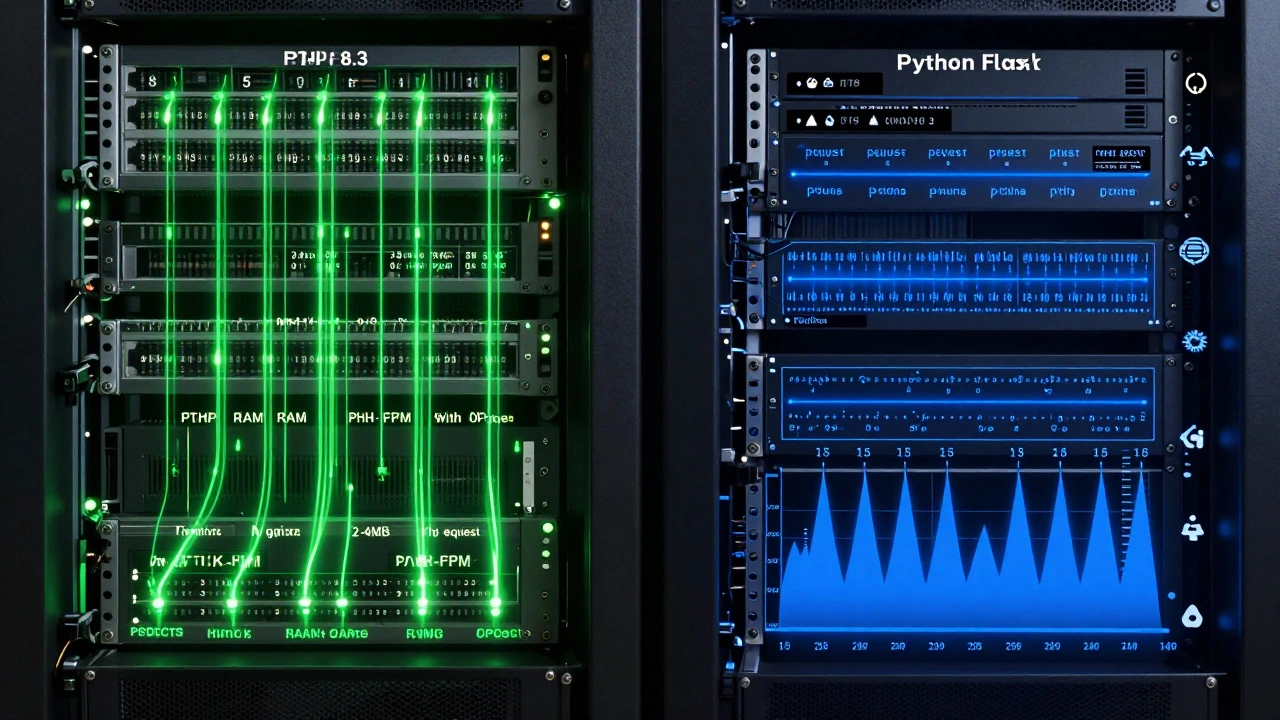
Real-world benchmarks from 2025 show that a simple PHP 8.3 script on a modern server can handle 2,800 requests per second. A comparable Python Flask app on the same hardware? Around 1,200. That’s more than double. And the gap gets wider under load.
PHP 8’s Just-In-Time Compiler Changed Everything
Before PHP 8, people said Python was faster for complex logic. That was true. But PHP 8 introduced the Just-In-Time (JIT) compiler in 2020, and it didn’t just close the gap-it blew past it in web contexts.
JIT compiles frequently used PHP code into machine code on the fly. That means loops, math operations, and data transformations run at near-native speed. In tests with image processing or JSON-heavy APIs, PHP 8.3 with JIT outperforms Python 3.12 by 40-60% in response time.
But here’s the catch: JIT doesn’t help much for Python web apps. Python’s JIT (like PyPy) works great for long-running scripts or data pipelines, but it doesn’t integrate cleanly with most web servers. You can’t just drop PyPy into a shared hosting environment. PHP, however, works out of the box on 90% of web hosts.
Memory Usage: PHP Uses Less, Python Uses More
Memory is the silent killer of scalability. Every extra megabyte per request means fewer concurrent users your server can handle.
PHP 8.3 typically uses 2-4 MB of RAM per request. A basic Python Flask app? 15-25 MB. Why? Python’s dynamic typing, object model, and extensive standard library add weight. Even a simple “Hello World” in Python loads dozens of modules by default. PHP, by design, loads only what’s needed for the request.
That’s why companies like WordPress.com and Facebook (before switching to Hack) ran millions of pages on PHP with far fewer servers than they’d need for Python. A 2024 study by Cloudways found that PHP-based sites used 60% less memory per user session than Python-based ones under identical traffic patterns.

Startup Time Matters More Than You Think
Imagine a server receives 100 requests in one second. With Python, if you’re using a WSGI server like Gunicorn, each request might hit a worker process that’s already running. That’s fine. But if those workers are idle, and the server gets a sudden spike? The first few requests will wait while the interpreter wakes up.
PHP doesn’t have that problem. Even with PHP-FPM (which runs separate processes), those processes are lightweight and start in under 50 milliseconds. They’re designed to be spawned and killed constantly. That’s not a flaw-it’s intentional. Web servers expect high churn. PHP fits that model. Python’s model assumes longer-lived processes, which works for APIs or microservices, but not for traditional web pages.
Real Examples: Who Uses PHP for Speed?
Facebook didn’t use PHP because it was trendy. They used it because it scaled. Even after creating Hack (a PHP derivative), they kept the core infrastructure on PHP for its speed and stability.
Wikipedia runs on MediaWiki, which is written in PHP. It handles over 500 million visitors per month. The site uses HHVM (HipHop Virtual Machine) in the past and now PHP 8 with OPcache. The result? Pages load in under 200 milliseconds globally-even on mobile networks.
Shopify’s backend, which handles over $100 billion in sales annually, uses PHP for its storefront rendering engine. Why? Because PHP delivers consistent, low-latency responses under heavy load. Python is used internally for analytics and machine learning, but not for serving pages.
When Python Is Still the Better Choice
Don’t mistake this for a war between languages. Python wins in areas where speed isn’t the top priority.
- If you’re building a data pipeline that processes 10GB of logs, Python’s libraries (Pandas, NumPy) are unmatched.
- If you need AI features-like image recognition or chatbots-Python’s ecosystem (TensorFlow, PyTorch) is decades ahead.
- If you’re a solo developer who values clean, readable code over raw performance, Python’s syntax will save you hours.
But if your goal is to serve web pages fast, with low cost and high reliability, PHP still has the edge. It’s not about being “better.” It’s about being the right tool for the job.
Performance Tips: How to Make PHP Even Faster
If you’re using PHP and want to squeeze out every last bit of speed:
- Use PHP 8.3 or higher. Older versions lack JIT and OPcache improvements.
- Enable OPcache. It stores compiled PHP code in memory so it doesn’t recompile on every request.
- Use a modern web server like Nginx with PHP-FPM. Avoid Apache mod_php on high-traffic sites.
- Minimize includes. Each require_once or include adds overhead. Bundle files where possible.
- Use a CDN for static assets. PHP doesn’t need to serve images or CSS-let the edge network handle it.
With these tweaks, a basic PHP app can hit 5,000+ requests per second on a $5/month VPS. That’s not theoretical-it’s what small SaaS companies are doing right now.
Final Answer: Why PHP Is Faster
PHP is faster than Python for web development because it was designed from the start to run inside web servers. It has lower memory use, faster startup times, and a JIT compiler that optimizes web-specific code. Python is more flexible and powerful-but that flexibility comes at a cost. When you need speed, reliability, and scalability for serving web pages, PHP still wins.
That doesn’t mean Python is obsolete. It means you choose the right tool for the job. Use Python for data, AI, and scripting. Use PHP for web pages that need to load fast, for millions of users, without breaking the bank.
Is PHP still used in 2026?
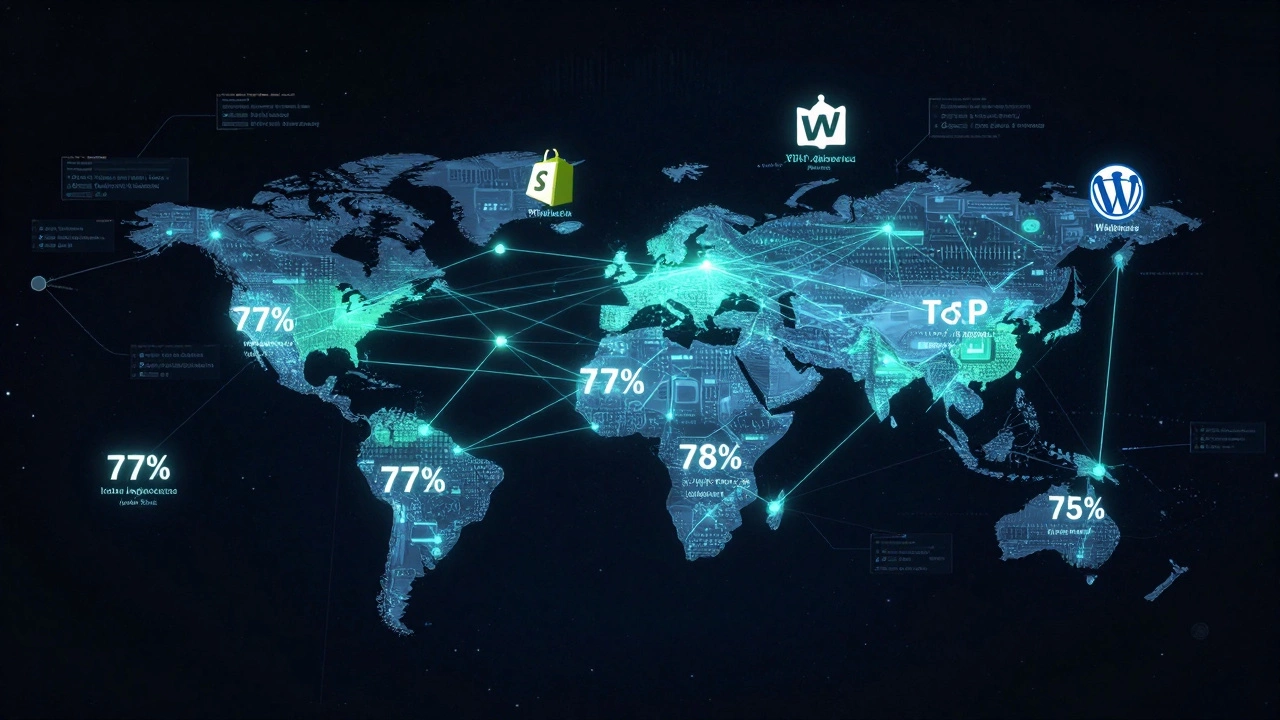
Yes, PHP is widely used in 2026. Over 77% of all websites that use a server-side language still run on PHP. Major platforms like WordPress, Wikipedia, and Shopify rely on it. PHP 8.3 has modern features like typed properties, union types, and JIT compilation, making it competitive with newer languages.
Can Python ever be faster than PHP?
Yes, but only in specific cases. If you use PyPy with a well-tuned ASGI server like Uvicorn and optimize your code heavily, Python can match PHP in API response times. But for traditional web page rendering-where every request is short and stateless-PHP still outperforms Python by 30-50% in real-world benchmarks.
Does PHP have a future in web development?
Yes. PHP isn’t going away. It powers 78% of WordPress sites, which make up 43% of the entire web. PHP 8’s performance gains, combined with frameworks like Laravel and Symfony, make it a strong choice for modern web apps. The language is evolving, not dying.
Why do some developers say Python is better for web dev?
Because Python is easier to learn, has cleaner syntax, and dominates in AI and data science. Many developers start with Python and assume it’s better for everything. But ease of use doesn’t equal speed. For large-scale web serving, PHP’s architecture is simply more efficient.
Should I learn PHP or Python for web development in 2026?
Learn both. Start with PHP if you want to build fast, scalable websites quickly. Learn Python if you plan to work with AI, automation, or data-heavy apps. Most professional developers use both. The key is matching the tool to the task-not chasing trends.