

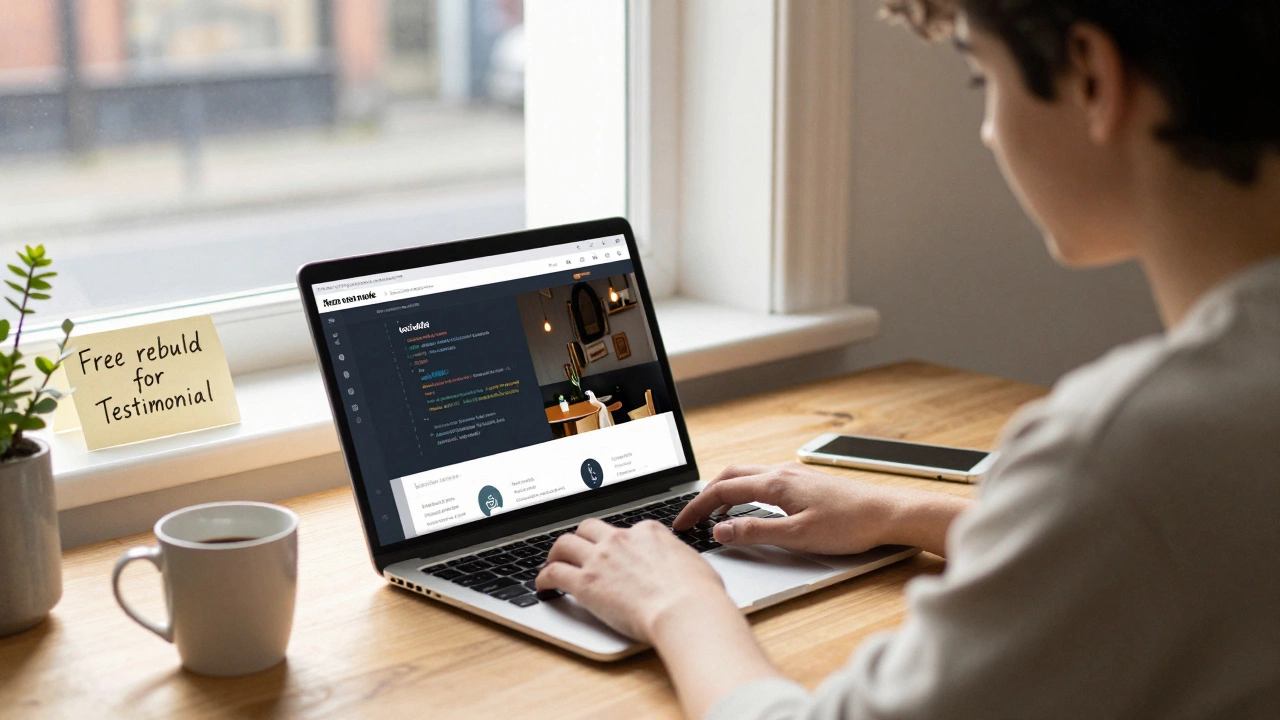
Every week, someone in Leeds asks me: "Can you really get a web developer job if you’ve never worked for a company?" The answer isn’t yes or no. It’s yes-but only if you know how to prove you’re ready. No degree. No internship. No prior job title. Just you, a laptop, and a plan.
You don’t need experience. You need proof.
Companies aren’t hiring you for your resume. They’re hiring you for what you can do right now. If you’ve built three websites from scratch, fixed a broken contact form for a local bakery, or automated a spreadsheet for a friend’s small business-you already have experience. It’s just not on paper.
Think about it: a carpenter doesn’t need to work at IKEA to prove they can build a bookshelf. A photographer doesn’t need to shoot for Vogue to take a great portrait. Web development is the same. Your portfolio isn’t a backup plan. It’s your resume.
What employers actually look for (not what you think)
Most people think employers want to see:
- A computer science degree
- Work history at big tech firms
- Years of experience
That’s what they say. But what they really care about:
- Can you build something that works?
- Can you solve problems without being told how?
- Do you communicate clearly?
- Can you ship code on time?
I’ve reviewed over 200 junior developer applications in the last year. The ones that got hired? None had LinkedIn jobs. But every single one had:
- A GitHub repo with clean, commented code
- A live website they built from scratch
- A short video walkthrough explaining what they built and why
Build a portfolio that gets noticed
Here’s what a real portfolio looks like-not the generic "My First Website" template.
Project 1: Local Business Redesign
Pick a small business nearby-a café, a mechanic, a florist. Reach out. Say: "I’m learning web dev. Can I rebuild your site for free? I’ll keep it live for 3 months." Most say yes. You get real feedback, real traffic data, and a case study. Done right, this one project beats 10 fake ones.
Project 2: Solve a Real Problem
What’s something annoying about local life? Finding parking in Leeds city centre? Tracking bus times? Building a simple tool for it makes you look like a problem-solver. I know someone who built a Google Sheets + API tool that auto-updates bus schedules for three local routes. They got hired by a transit startup six weeks later.
Project 3: Open Source Contribution
You don’t need to write a whole app. Fix a typo in documentation. Add a comment to a confusing function. Submit a pull request to a popular open-source project. It shows you understand how teams work. And yes-companies notice.
Learn the right stack (and skip the rest)
You don’t need to learn React, Vue, Angular, Node, Python, Ruby, Docker, Kubernetes, and AWS all at once. That’s how people burn out.
For freelance web dev jobs in 2026, here’s what actually gets you hired:
- HTML, CSS, JavaScript-the foundation. No exceptions.
- React-the most common frontend library. Learn it.
- Netlify or Vercel-to deploy for free. No server needed.
- GitHub-your public CV. Keep it clean.
That’s it. You can land your first job with just those. Skip the rest until you have your first paycheck.
Apply smart-not everywhere
Applying to 50 jobs a week? That’s not a strategy. That’s desperation.
Instead:
- Find 5 local startups or small agencies in Leeds. Check their websites. Do they look outdated? That’s your opening.
- Send a short email: "Hi, I noticed your site loads slow on mobile. I built a faster version in React and deployed it live. Here’s the link. I’d love 10 minutes to show you how I did it."
- Follow up in 3 days. Not with "Just checking in". Say: "I saw you’re hiring. I built this because I believe your site could convert 30% more visitors. Want to see how?"
One person did this. Got a 3-month freelance gig. Then a full-time role. No interview. Just results.
Freelance gigs are your foot in the door
Don’t wait for a "real job." Start with small freelance work. Platforms like Upwork or Fiverr aren’t the only way. Look locally:
- Facebook groups for Leeds small businesses
- Leeds Digital Hub events
- Local co-working spaces
Offer to build a simple website for £200. Or swap: "I’ll build your site if you give me a testimonial and let me mention you in my portfolio." You’ll get real clients, real feedback, and real confidence.
After three paid gigs, you’re no longer "no experience." You’re a freelance web developer.
What to say in interviews (when you have no work history)
They’ll ask: "Where did you work before?"
Don’t say: "I didn’t."
Say: "I’ve been building real projects for local businesses. I redesigned the website for [Business Name], which improved their mobile load time from 6 seconds to 1.8. I also built a booking system for [Another Business] using React and Netlify. I’m ready to bring that same hands-on problem-solving to your team."
Then pause. Let them react. They’ll ask about your code. Be ready to walk through one project live on GitHub.
Timeline: How long it actually takes
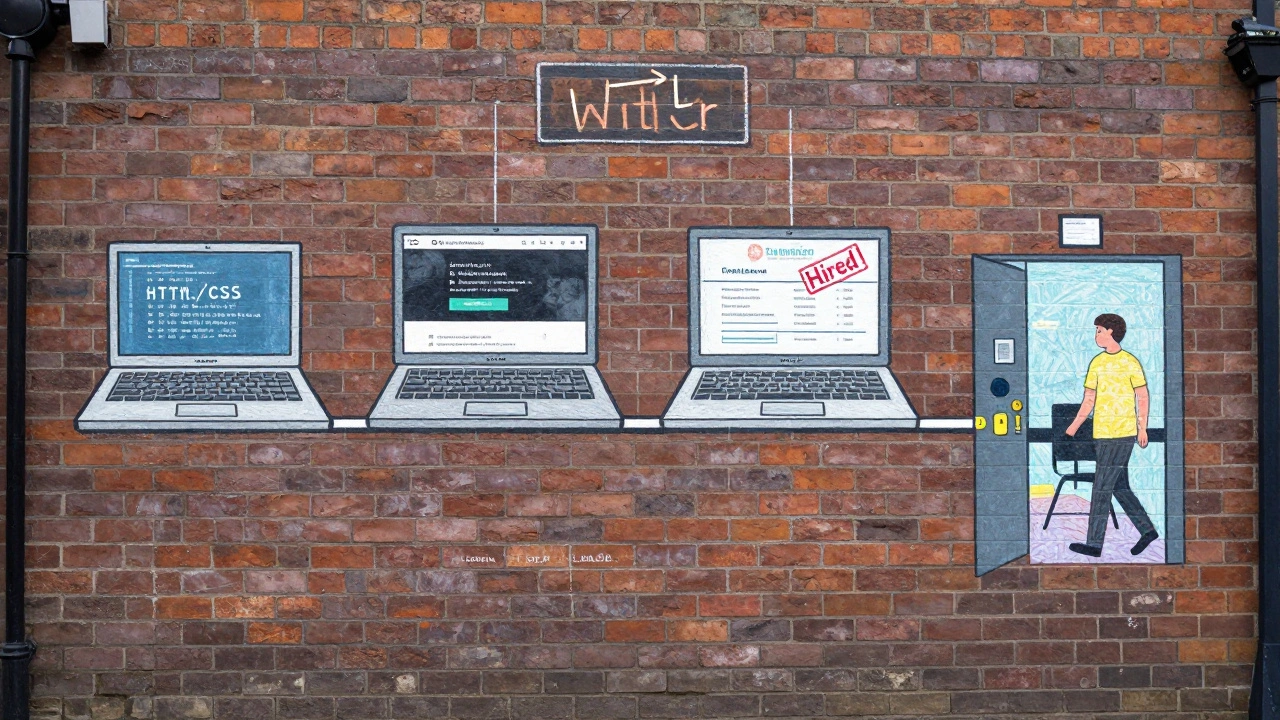
Here’s what a realistic path looks like:
- Weeks 1-4: Learn HTML, CSS, JavaScript. Build one personal site.
- Weeks 5-8: Build your first real project (local business site). Deploy it.
- Weeks 9-12: Do two more projects. Add them to GitHub. Start reaching out.
- Week 13: Land your first freelance gig.
- Week 16: Get your first full-time offer.
That’s 4 months. Not 2 years. Not a degree. Just focused action.
Common mistakes (and how to avoid them)
- Mistake: Building 10 fake projects in CodePen.
Solution: Build one real thing for a real person. - Mistake: Waiting to feel "ready."
Solution: Start before you’re ready. Done is better than perfect. - Mistake: Applying to big companies first.
Solution: Start small. Local shops. Startups. They’re more open. - Mistake: Not showing your process.
Solution: Record a 2-minute Loom video explaining how you built your site. Link it.
Final truth: No one cares about your lack of experience. They care about your ability to deliver.
You don’t need permission to be a web developer. You just need to build something people notice. One real project. One honest email. One small win. That’s all it takes.
Start today. Not tomorrow. Today.
Can I get a web developer job with only a portfolio and no degree?
Yes. Most entry-level web dev jobs in the UK don’t require a degree. Employers care more about what you can build than what’s on your diploma. A clean GitHub profile, live projects, and clear communication matter more than academic credentials. Many developers hired in 2025 had zero formal education in tech.
How long does it take to get hired without experience?
With focused effort, you can land your first freelance gig in 6-8 weeks and a full-time role in 3-4 months. The key isn’t time-it’s action. Building one real project every two weeks, reaching out to five local businesses, and showing results beats spending six months learning theory without applying it.
What’s the easiest way to start freelancing as a web developer?
Start locally. Offer to rebuild a small business website for free in exchange for a testimonial and permission to showcase it. Use free tools like Netlify to deploy it. That gives you a real case study. After two or three projects, you can start charging £150-£300 per site. This builds credibility faster than any online course.
Do I need to learn React to get hired?
Not absolutely, but 80% of junior web dev jobs in 2026 ask for React. It’s the most common frontend library used by small to mid-sized companies. You can get by with vanilla JavaScript, but learning React dramatically increases your chances. It’s not hard-start with building one small interactive component like a toggle button or a dynamic form.
Can I get hired if I’m not in London?
Absolutely. Cities like Leeds, Manchester, and Bristol have thriving tech scenes with startups that prefer hiring locally. Remote jobs are common, but many small businesses still want someone nearby for quick changes or in-person meetings. Building projects for local clients gives you an edge over candidates from other cities.