

Backend Language Suitability Analyzer
Step 1: Select Your Primary Backend Language
Choose the language you're considering for your project:
PHP
Web Apps & CMSNode.js
Full-Stack JSPython
Data & AIGo
MicroservicesStep 2: Rate Your Project Requirements
How important are these factors for your project?
Analysis Complete!
Your Selected Language Score
Recommended Alternative
Why This Recommendation?
It used to be impossible to build a website without touching PHP is a server-side scripting language designed primarily for web development that produces dynamic web pages. It powers roughly 75% of all websites with a known server-side programming language, including giants like Facebook and Wikipedia. But if you walk into a modern tech meetup or browse recent job postings, the conversation has shifted. You hear about JavaScript frameworks, Python microservices, and Go backends. So, did everyone actually stop using PHP? Not exactly. But the enthusiasm has definitely cooled. The question isn't just about code; it's about culture, performance expectations, and how the web itself has changed from static documents to complex applications.
The Rise of JavaScript and the Full-Stack Promise
The biggest factor in PHP's perceived decline is the explosive growth of JavaScript is a high-level, interpreted programming language that conforms to the ECMAScript specification, widely used for both frontend and backend development. For years, developers had to learn two completely different languages: one for what users see in the browser (HTML/CSS/JS) and one for what happens on the server (PHP). This split created friction. Debugging was harder, context switching was exhausting, and hiring required finding specialists in both areas.
Then came Node.js is a cross-platform, open-source JavaScript runtime environment that executes JavaScript code outside a web browser. Suddenly, you could write the entire application in one language. If you knew JavaScript, you could build the frontend interface and the backend API. This "full-stack" promise was irresistible to startups and agencies looking to move fast. A single developer could handle everything from database queries to user interface animations. PHP couldn't offer this unified experience because it lives strictly on the server side. While PHP remains excellent for its specific role, the convenience of a single-language stack drew many new developers away.
The Performance Perception Gap
Performance is another area where PHP took a hit, largely due to perception rather than raw capability. In the early 2010s, benchmarks often showed newer languages like Go is an open-source programming language designed at Google that makes it easy to build simple, reliable, and efficient software or Rust is a multi-paradigm systems programming language focused on safety, especially concurrent safety crushing PHP in request-per-second tests. Even though modern PHP versions, particularly PHP 8.0 and later, introduced Just-In-Time (JIT) compilation and significant speed improvements, the reputation stuck. Developers associate PHP with the slow, bloated sites of the past.
Consider a typical e-commerce site. In the old days, a PHP script would connect to the database, fetch data, render HTML, and send it back. Simple. Today, users expect real-time inventory updates, live chat, and personalized recommendations without page reloads. These features rely heavily on WebSockets and asynchronous processing-areas where event-driven architectures like Node.js shine naturally. PHP traditionally operates in a synchronous, request-response model. While tools like Swoole or ReactPHP allow PHP to handle async tasks, they add complexity that many teams prefer to avoid by choosing a language built for concurrency from the ground up.
The WordPress Shadow
We cannot talk about PHP without addressing WordPress is a free and open-source content management system written in PHP and paired with a MySQL or MariaDB database. WordPress powers over 40% of the web. On one hand, this keeps PHP alive. On the other hand, it creates a stigma. Many developers view PHP as merely "the language behind WordPress." When people think of PHP, they imagine theme conflicts, plugin bloat, and security vulnerabilities caused by poorly coded third-party extensions. They don't think of enterprise-grade architecture or clean object-oriented design.
This association hurts PHP's credibility among developers building custom, scalable applications. If you are a startup founder looking to build a unique SaaS product, you might hesitate to choose the language associated with blogging platforms and small business brochures. You might opt for Python is a high-level general-purpose programming language whose design philosophy emphasizes code readability with the use of significant indentation with Django or Flask, which carry a more "professional" or "data-science-friendly" aura. This psychological barrier is real. It pushes talented engineers toward languages that feel more aligned with cutting-edge technology, even if PHP could technically do the job just as well.
Modern Frameworks vs. Legacy Code
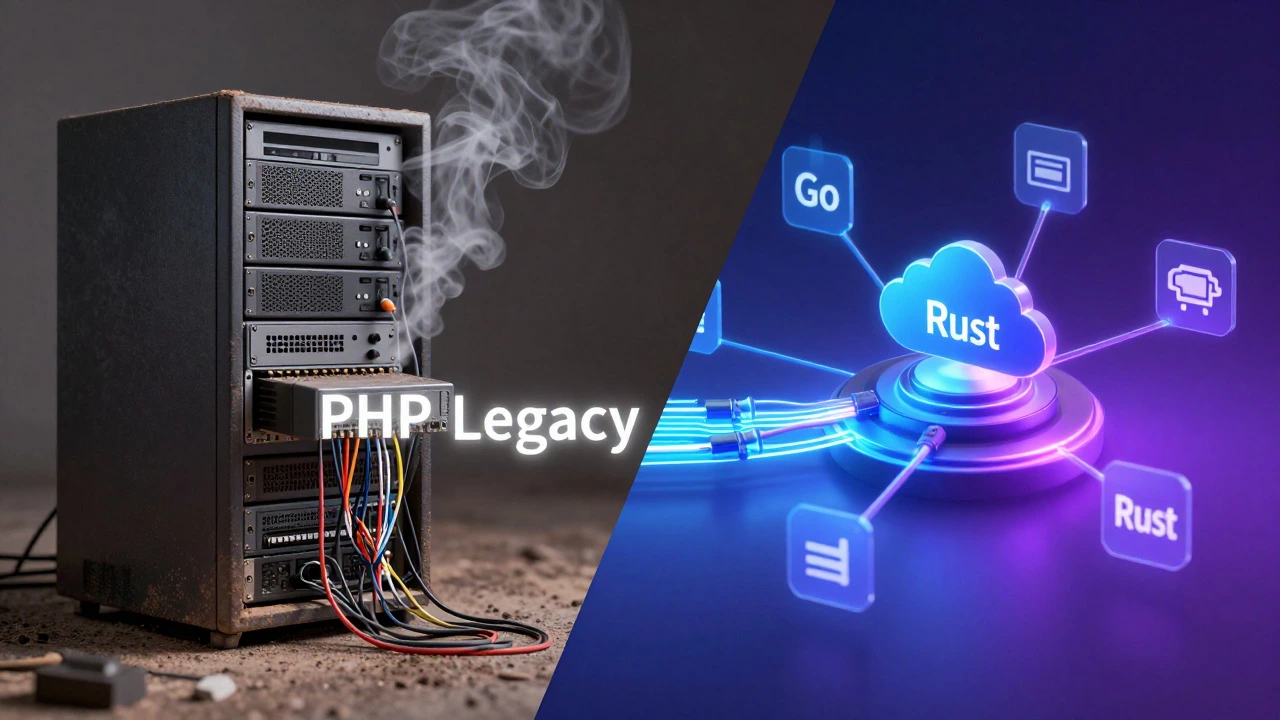
Another reason developers drift away is the quality of legacy codebases. PHP has been around since 1995. Over three decades, millions of lines of spaghetti code have been written. Global variables, mixed HTML and logic, and inconsistent coding standards are common in older projects. New developers inheriting these codebases often feel frustrated. They spend more time untangling messy logic than building new features.
In contrast, modern ecosystems enforce stricter discipline. TypeScript is a strongly typed superset of JavaScript that compiles to plain JavaScript catches errors before runtime. Rust prevents memory leaks through its borrow checker. Even Java has matured with strict enterprise patterns. While PHP has improved significantly with strong typing, namespaces, and powerful frameworks like Laravel is a free, open-source PHP web framework following the model-view-controller architectural pattern, it still struggles against the inertia of its own history. Learning Laravel is great, but explaining to a junior developer why the previous senior dev used `$_GET` directly in the template file is a headache. Modern languages start with better defaults, making them more attractive for greenfield projects.
| Language | Primary Use Case | Learning Curve | Ecosystem Strength |
|---|---|---|---|
| PHP | Web Applications, CMS | Low | Very High (WordPress, Laravel) |
| JavaScript (Node.js) | Full-Stack Apps, Real-time Services | Medium | Extremely High (NPM) |
| Python | Data Science, AI, Web APIs | Low | High (Django, Flask, PyTorch) |
| Go | Microservices, Cloud Infrastructure | Medium | Growing (Cloud Native) |
Is PHP Actually Dead?
Let's be clear: PHP is not dead. It is simply no longer the default choice for every new project. The narrative that "everyone stopped using PHP" is an exaggeration driven by hype cycles. Major companies still rely on it because rewriting millions of lines of stable, profitable code in a new language is risky and expensive. Facebook, which originally wrote its entire platform in PHP, created Hack (a dialect of PHP) and HHVM (HipHop Virtual Machine) to optimize it further. They didn't switch to Java or C++ entirely; they evolved their PHP infrastructure.
Furthermore, the PHP community is vibrant. Releases like PHP 8.1, 8.2, and 8.3 have brought union types, readonly properties, and fibers. These features make PHP competitive with modern statically-typed languages. The issue isn't the language's capability; it's the market's attention span. Developers chase novelty. PHP feels familiar, sometimes too familiar. It lacks the "cool factor" of WebAssembly or Serverless functions, even though it runs perfectly well in those environments.

When Should You Still Choose PHP?
If you are deciding whether to use PHP today, consider your specific needs. PHP remains an outstanding choice for content-heavy websites, blogs, and traditional e-commerce stores. If your primary goal is rapid deployment with a massive library of pre-built plugins, WordPress combined with PHP is unbeatable. The cost of hosting is also lower for PHP compared to some resource-intensive alternatives, as it doesn't require keeping long-lived processes in memory for every request in the same way Node.js does.
Additionally, the talent pool for PHP is enormous. Finding a competent PHP developer is easier and often cheaper than finding a specialized Go or Rust engineer. For agencies working with tight budgets and quick turnaround times, PHP delivers value faster. The key is to use modern practices: employ Composer for dependency management, use a framework like Symfony or Laravel, implement automated testing, and separate your frontend from your backend using RESTful APIs. Done right, PHP is robust, secure, and scalable.
The Future of Web Development Languages
The shift away from PHP reflects a broader trend in software engineering: specialization. We are moving away from "one size fits all" languages toward tools optimized for specific jobs. JavaScript dominates the interactive layer. Python leads in data and machine learning. Go excels in distributed systems. PHP holds its ground in content management and traditional web services. Understanding this landscape helps you make informed decisions rather than following trends blindly. The best language is the one that solves your problem efficiently, not the one with the most buzz on social media.
Is PHP still worth learning in 2026?
Yes, absolutely. Despite the hype around newer languages, PHP powers a significant portion of the web. Learning PHP opens doors to maintaining existing large-scale systems and working with WordPress, which remains a dominant force in web publishing. Additionally, modern PHP frameworks like Laravel provide a sophisticated development experience comparable to other top-tier languages.
What is the main advantage of Node.js over PHP?
The primary advantage is the ability to use a single language (JavaScript) for both frontend and backend development. This reduces context switching for developers and simplifies team structure. Node.js also handles asynchronous I/O operations very efficiently, making it ideal for real-time applications like chat apps or collaborative tools.
Why do some developers dislike PHP?
Many criticisms stem from PHP's inconsistent function naming conventions in earlier versions and the prevalence of poorly written legacy code. The association with insecure or bloated WordPress sites also contributes to a negative perception among developers who prioritize clean architecture and strict typing.
Can PHP handle high-traffic websites?
Yes. With proper optimization, caching strategies (like Redis or Memcached), and modern execution engines (such as OPcache), PHP can handle millions of requests per day. Social media giant Facebook started as a PHP application and continues to run core parts of its infrastructure on evolved PHP variants.
How does PHP compare to Python for web development?
Python is generally considered more readable and versatile, especially for integrating data science or AI features. However, PHP is often faster to deploy for pure web-centric tasks due to its extensive ecosystem of web-specific tools and hosting support. Python requires more setup for production web servers compared to PHP's native integration with Apache and Nginx.