
When you ask what framework web developers are using in 2024, the answer isn’t a mystery-it’s written in the code of millions of websites. If you’ve visited any modern site built in the last three years, chances are it’s powered by React. Not because it’s the flashiest or the newest, but because it just works-reliably, scalably, and with a community that never sleeps.
React dominates the landscape
In 2024, React holds over 40% of the frontend framework market share, according to the State of JS survey. That’s more than double the next closest competitor. Companies like Facebook, Instagram, Airbnb, and Netflix still rely on it to serve billions of interactions daily. Why? Because React lets teams build complex interfaces without breaking a sweat. Its component-based structure means one team can work on a button while another handles the checkout flow, and everything stays in sync.
React isn’t just popular because it’s easy. It’s popular because it’s predictable. You write a component, define its state, and it re-renders only what needs updating. No more reloading entire pages. No more messy DOM manipulations. Just clean, reusable pieces that behave the same way every time.
How React compares to other frameworks
Let’s be clear: React isn’t the only option. But the others are playing catch-up.
Vue.js has a loyal following, especially among smaller teams and startups. It’s lightweight and gentle on newcomers. But its growth has plateaued. The Vue 3 upgrade helped, but adoption hasn’t surged like React’s did in 2018. Angular? It’s still used in enterprise environments-banks, government portals, big healthcare systems. But it’s heavy. You need TypeScript, RxJS, and a whole build system just to render a button. Most developers today don’t want that overhead.
Then there’s Svelte. It’s elegant. It compiles away the framework at build time, leaving pure JavaScript. It’s fast. But it’s still niche. Fewer libraries, fewer jobs, fewer tutorials. If you’re building a personal project, Svelte is fun. If you’re building something your company will maintain for five years? React is the safe bet.
Here’s a quick snapshot of the 2024 landscape:
| Framework | Market Share | Learning Curve | Job Postings (UK) | Community Support |
|---|---|---|---|---|
| React | 41% | Medium | 12,400+ | Excellent |
| Angular | 15% | Steep | 3,200+ | Strong |
| Vue.js | 12% | Easy | 1,800+ | Good |
| Svelte | 5% | Easy | 450+ | Moderate |
| Next.js | 38% | Medium | 9,100+ | Excellent |
Notice Next.js? That’s not a separate framework-it’s a React-based framework. And it’s growing faster than React itself. Why? Because it solves React’s biggest weakness: server-side rendering and SEO. Next.js lets you build fast, SEO-friendly websites with React’s flexibility. It’s now the go-to choice for startups, e-commerce sites, and blogs that need to rank on Google.
Why React won’t be dethroned soon
Some say React is old. That’s true-it launched in 2013. But old doesn’t mean outdated. It means proven. Facebook (now Meta) still invests millions into React every year. The core team releases updates every few months, and they’re always backward-compatible. You can upgrade from React 17 to React 18 without rewriting your entire app.
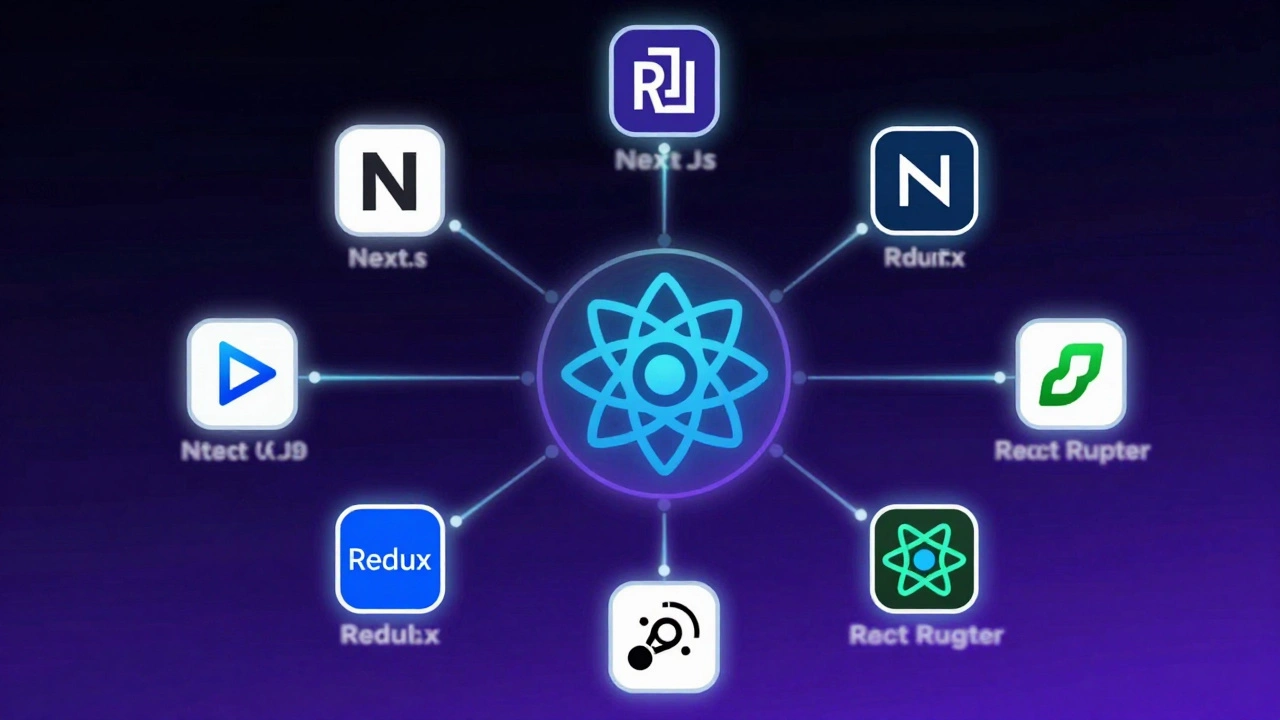
Then there’s the ecosystem. React has over 200,000 npm packages built just for it. State management? Redux, Zustand, Jotai. Routing? React Router. Form handling? React Hook Form. UI components? Material UI, Chakra UI, Tailwind CSS-all built to work with React. You don’t need to build from scratch. You plug in what you need.
And the talent pool? Massive. In the UK alone, over 12,000 job postings in 2024 asked for React skills. That’s more than any other frontend technology. If you learn React, you’re not just learning a tool-you’re learning the language of modern web development.
Who should use React?
If you’re starting out, React is the best place to begin. It’s not the easiest framework to learn, but it’s the most transferable. Once you understand React, you can pick up Next.js, Remix, or even Vue with far less effort. It teaches you how components, state, and props work-concepts that apply everywhere.
If you’re in a company building a product that will scale, React gives you room to grow. You can start with a simple landing page and end up with a full-blown SaaS platform. Many teams start with React and Next.js, then add TypeScript, Prisma, and a headless CMS as they grow. It’s a stack that scales with you.
Even if you’re not building a website-say, you’re making a desktop app with Electron, or a mobile app with React Native-you’re still using React. The same skills transfer. That’s rare in tech.
What about the alternatives?
Yes, there are other options. But they’re better suited for specific cases.
- Vue.js is great for small teams, nonprofits, or developers who want to ship fast without a steep learning curve.
- Angular still makes sense for large enterprises with strict governance, compliance needs, or legacy systems.
- Svelte shines for performance-critical apps with limited resources-think embedded dashboards or low-power devices.
- Next.js is the real winner if you need SEO, fast loading, and React’s power together.
But none of them have the same breadth of support, documentation, or job opportunities. If you’re choosing a framework to build your career, React is the only one that guarantees you’ll be relevant in 2025, 2026, and beyond.

What’s next for React?
React 19 is coming in 2025. It’s not a rewrite-it’s an evolution. Server Actions, improved concurrent rendering, and better built-in state management are on the horizon. The goal? Make React even simpler to use, even faster to load, and even more powerful for building full-stack apps without leaving the React ecosystem.
That’s the pattern. React doesn’t reinvent itself every year. It refines. It improves. It listens. And that’s why it stays on top.
Final verdict
There’s no debate left. In 2024, React is the most used framework for web development. Not because it’s perfect. But because it’s the most practical. It’s the one that lets developers build real things, fast, without getting lost in complexity.
If you’re learning web development, start with React. If you’re hiring, look for React skills. If you’re building something that matters, bet on React. It’s not just the most popular-it’s the most dependable.
Is React the only framework worth learning in 2024?
No, but it’s the most valuable. Learning React gives you access to 90% of the modern web job market. Other frameworks like Vue or Svelte are worth knowing if you’re working in niche areas, but React is the baseline. Once you master React, picking up other tools becomes much easier.
Should I learn React or Next.js first?
Learn React first. Next.js is built on top of React, so you need to understand components, state, and props before you can use Next.js effectively. Once you’re comfortable with React, moving to Next.js takes just a few days. It’s like learning to drive a manual car before switching to an automatic.
Is React good for SEO?
Plain React apps render on the client, which can hurt SEO. But Next.js fixes that by rendering pages on the server before sending them to the browser. If you care about search rankings, use Next.js with React-not React alone.
Do big companies still use React in 2024?
Yes. Facebook, Instagram, Airbnb, Uber, and even the UK government’s GOV.UK site use React. These aren’t startups-they’re massive platforms with millions of users. If React wasn’t reliable, they wouldn’t still be using it.
Is React hard to learn for beginners?
It’s not the easiest, but it’s the most rewarding. If you know HTML, CSS, and basic JavaScript, you can start building React apps in a week. The learning curve flattens fast once you understand components and props. There are more tutorials, courses, and free resources for React than any other framework.
If you’re wondering where to start, pick up a free Next.js tutorial on the official React website. Build a simple blog. Deploy it on Vercel. That’s how most professionals got started-and how you will too.