

People often ask if Python is a front-end or back-end language. The short answer? It’s not either - it’s both. But that doesn’t mean it’s equally common in both. Most developers use Python for the back end, and for good reason. But you can use it on the front end too - if you’re willing to work a little harder.
What Python Does Best: The Back End
Python’s real strength lies in server-side development. That’s where you’ll find it powering the logic behind websites - handling user logins, processing payments, talking to databases, and serving up content to browsers. Frameworks like Django and a high-level Python web framework that encourages rapid development and clean design. Also known as Django Framework, it was first released in 2005 and has since powered millions of websites. and Flask and a lightweight Python web framework that gives developers flexibility to build web applications with minimal boilerplate. First released in 2010, Flask is known for its simplicity and is widely used in startups and small projects. are built for this. They handle routing, authentication, database connections, and API creation without forcing you to reinvent the wheel.
Companies like Instagram, Spotify, and Dropbox built their core systems on Python. Why? Because it’s readable, fast to develop with, and scales well. A single Python script can connect to PostgreSQL, validate user input, call an external payment API, and log the result - all in under 50 lines. Compare that to doing the same in JavaScript on the server, and you’ll see why Python dominates back-end work.
Can Python Run in the Browser? Yes - But It’s Rare
You might have heard of PyScript and a framework that lets developers write Python code to run directly in web browsers using WebAssembly and JavaScript interop. Released in 2022, PyScript is still experimental and used mostly for educational demos and small tools. or Transcrypt and a Python-to-JavaScript compiler that allows developers to write Python code and compile it into JavaScript for browser execution. First introduced in 2015, Transcrypt is used in niche applications where developers prefer Python syntax over JavaScript.. These tools let you write Python code that runs in the browser. But here’s the catch: they’re not mainstream. You won’t find them on Airbnb, Netflix, or Amazon. Why? Because browsers were built for JavaScript. Everything - from event handling to DOM manipulation - works best with JS.
Try building a dynamic form with real-time validation using PyScript. You’ll spend more time debugging browser compatibility than actually building features. JavaScript libraries like React and Vue have years of optimization behind them. Python tools? Not so much. If you’re building a production app, you’ll still need JavaScript for animations, user interactions, and real-time updates. Python in the browser is more of a curiosity than a solution.
Why Most Developers Stick to JavaScript for Front-End
Front-end development means one thing: the browser. And the browser speaks JavaScript. HTML and CSS set up the structure and style, but JavaScript brings everything to life - dropdown menus, form validation, loading spinners, live search, drag-and-drop. Even if you use React, Vue, or Svelte, they all compile down to JavaScript under the hood.
There’s no native alternative. You can’t use Python directly in Chrome, Firefox, or Safari. You need a compiler to translate it - and that adds complexity, file size, and latency. Every extra layer slows things down. For most projects, that’s not worth it.
Think about it: if you’re a front-end developer, you already know JavaScript. Why learn Python just to write UI code when you can do it faster and more reliably with JS? The ecosystem is richer. Tools like Vite, Webpack, and npm are built around JavaScript. Libraries like Chart.js, Lottie, and Three.js? All JavaScript. Python doesn’t have equivalents that match.

When Python Might Show Up on the Front End
There are exceptions. If you’re building a data-heavy dashboard - say, visualizing real-time sensor data from a lab - you might use Python to process the numbers and then send them to the browser as JSON. The front end still uses JavaScript to render charts, but the heavy lifting happens in Python on the server.
Some educational tools use Python in the browser to teach coding. Platforms like Jupyter Notebook or Codecademy use Python in their interactive lessons. But these aren’t real websites - they’re learning environments.
Another case? Internal tools. A small team at a startup might use PyScript to let non-developers write simple automation scripts that run in the browser. It’s not scalable, but it’s handy for one-off needs.
Full Stack? Python Can Do It - But You’ll Still Need JS
If you’re aiming to be a full-stack developer, Python is a great back-end choice. But you still need to know JavaScript. You can’t avoid it. Even if your server is built with Django, your client-side code will be JavaScript. You’ll need to handle API calls, manage state, and respond to user input.
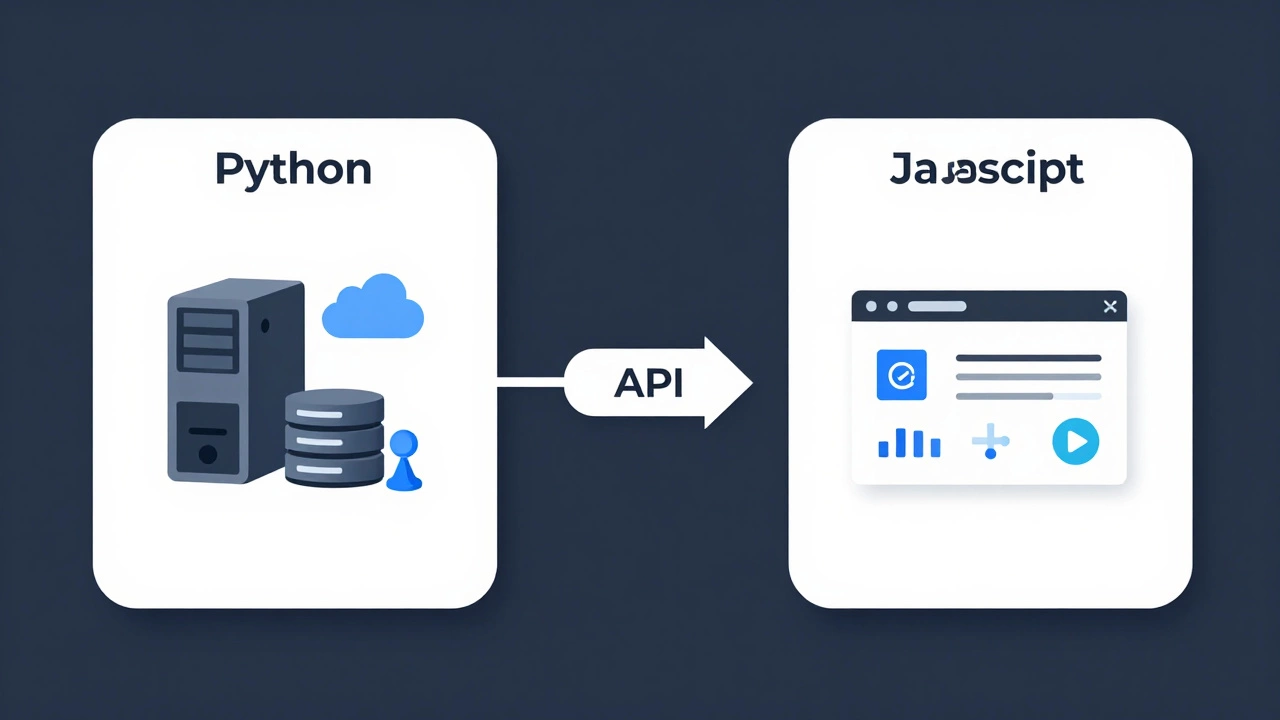
Here’s what a typical Python-based full-stack app looks like:
- Back end: Django or Flask handles the database, authentication, and business logic.
- API: REST or GraphQL endpoints serve JSON to the front end.
- Front end: React or vanilla JavaScript renders the UI and talks to the API.
You’re not replacing JavaScript - you’re pairing it with Python. And that’s powerful. Python handles the heavy, complex tasks. JavaScript handles the fast, interactive parts.
What Should You Learn First?
Here’s the practical advice:
- If you’re new to web dev - start with HTML, CSS, and JavaScript. Build a few static sites. Then learn React or Vue.
- If you want to build APIs, servers, or data pipelines - learn Python. Start with Flask. Then move to Django.
- If you’re already good with JavaScript - adding Python to your toolkit opens up back-end opportunities. You’ll be able to build full-stack apps faster.
There’s no rule that says you have to choose one. Many developers use Python for back-end work and JavaScript for front-end. That’s not a flaw - it’s the norm.
Bottom Line
Python isn’t a front-end language. It’s a back-end powerhouse. You can force it into the browser, but you shouldn’t. The web was built on JavaScript. Python complements it - it doesn’t replace it.
Use Python where it shines: servers, data, automation. Use JavaScript where it belongs: browsers, interactions, real-time UI. Together, they make a killer team. Don’t try to make Python do JavaScript’s job. Let each tool do what it’s best at.
Can I build a whole website with just Python?
Technically, yes - using frameworks like Django or Flask for the server and PyScript for the front end. But in practice, no. Browsers don’t natively run Python, so you’d be relying on experimental tools that add complexity, slow down performance, and lack community support. Real-world websites use JavaScript for front-end interactivity. Python is better suited for the back end.
Is Python faster than JavaScript for web development?
It depends on where you’re using it. On the server, Python often runs faster than Node.js for heavy data processing, thanks to libraries like NumPy and Pandas. But in the browser, JavaScript is always faster because it’s native. PyScript and Transcrypt compile Python to JavaScript, which adds overhead. For raw speed in the browser, JavaScript wins every time.
Do companies use Python for front-end development?
Almost none. Major companies like Google, Meta, and Amazon use JavaScript (or frameworks built on it) for their front ends. Python is used behind the scenes - for data analysis, API logic, and automation. There are no large-scale production websites built with Python on the front end. Any claims otherwise are either experimental demos or educational tools.
Should I learn Python if I want to be a front-end developer?
Not unless you plan to branch into full-stack roles. For pure front-end work, focus on JavaScript, HTML, CSS, and modern frameworks like React or Vue. Python won’t help you build better buttons or sliders. But if you want to connect your front end to a custom API or handle data processing, learning Python later will give you an edge in full-stack development.
What’s the best way to use Python and JavaScript together?
Use Python on the server to handle logic, databases, and APIs. Use JavaScript on the client to render the UI and respond to user input. For example, build a Django API that returns JSON data, then use React to fetch that data and display it in a dynamic dashboard. This is the standard pattern used by most modern web apps - and it works because each language does what it’s best at.