PHP Career Path Finder
Answer a few questions to discover which PHP specialization fits your goals best.
Your Recommended Path:



Answer a few questions to discover which PHP specialization fits your goals best.
The hate for PHP usually comes from people who remember version 4 or 5. Back then, the language was a bit of a wild west. You could mix HTML and logic in a way that made your head spin, and security was often an afterthought. But the industry has moved on. PHP 8 introduced Just-In-Time (JIT) compilation, which means the code executes much faster by compiling parts of it during runtime rather than every single time the page loads.
If you look at the current job market, the demand hasn't vanished; it has shifted. Companies aren't looking for someone to write raw PHP scripts from scratch. They want developers who can manage complex ecosystems. Think about the sheer volume of legacy code in the corporate world. Thousands of businesses rely on custom PHP apps that need maintaining, updating, and scaling. That's not a dying market; that's a goldmine for anyone who actually knows how to handle the language properly.
You don't just learn PHP; you learn the tools that make it useful. The biggest player here is undoubtedly WordPress. As the world's most popular content management system (CMS), it controls a massive chunk of the web. If you want to be a freelancer, knowing how to build custom themes and plugins for WordPress is a direct ticket to getting paid. You aren't just fighting for high-tech startup jobs; you're serving the millions of small businesses that need a functional website yesterday.
Then there's the "modern" side of the house. If you've heard people praising Laravel, you're hearing about the framework that saved PHP's reputation. Laravel is a web application framework with expressive, elegant syntax that handles things like routing, authentication, and database management with ease. It brings the "magic" of Ruby on Rails to the PHP world. When you use Laravel, you're using an Object-Relational Mapper (ORM) called Eloquent, which lets you interact with your database using PHP syntax instead of writing raw SQL queries all day.
| Feature | WordPress | Laravel |
|---|---|---|
| Primary Use Case | Blogs, Business sites, Simple Stores | Custom Web Apps, SaaS, Complex APIs |
| Learning Curve | Low (Easy to start) | Medium (Requires OOP knowledge) |
| Development Speed | Instant (Plug-and-play) | Fast (Structured framework) |
| Customizability | High (via Plugins/Themes) | Infinite (Full control) |
Is PHP the only choice? Of course not. You've probably heard about Node.js, which lets you use JavaScript on the server. The big appeal of Node.js is using one language for both the front and back end. It's great for real-time apps like chat systems or collaborative tools where data needs to move instantly via WebSockets.
Then there's Python, the king of data science and AI. If you're building a machine learning model or a complex data scraper, Python is the way to go. But for standard "request-response" web pages-where a user clicks a link and a server sends back a page-PHP is often simpler to deploy. You don't need a complex build process or a dedicated application server for basic PHP; you just upload the file to a server with Apache or Nginx, and it works. That simplicity is why cheap shared hosting is almost always built around PHP.
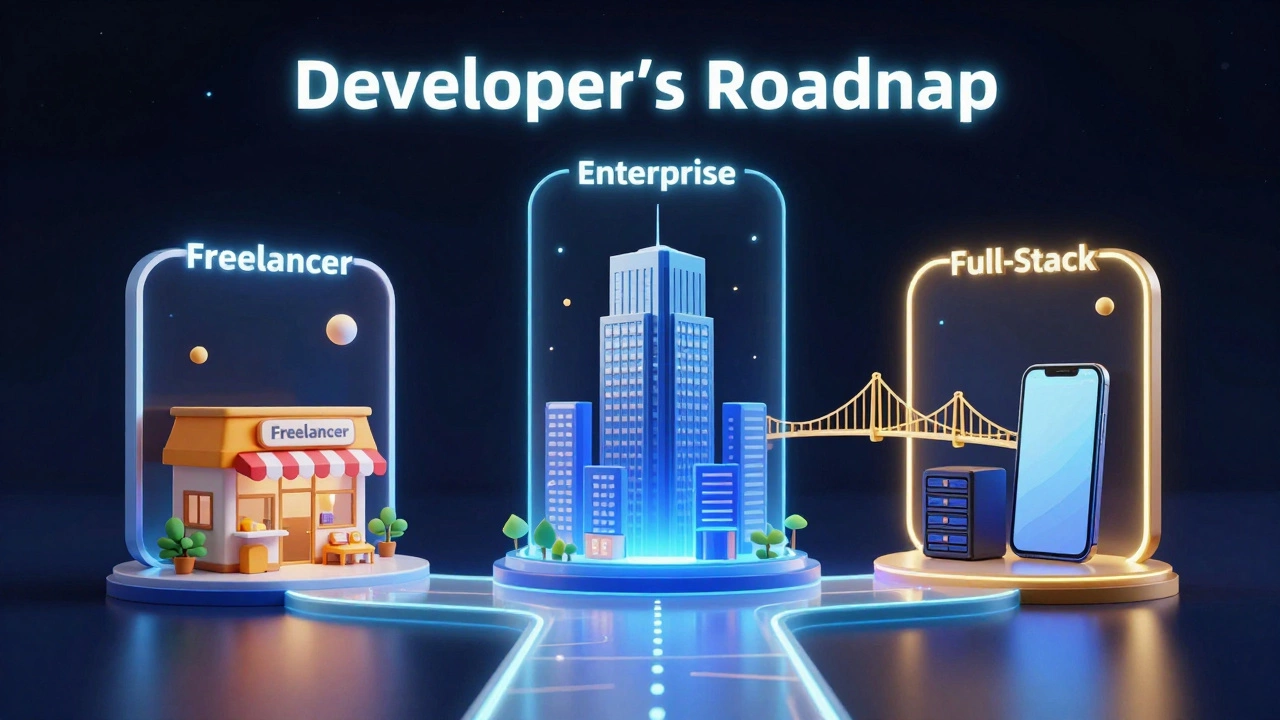
If you're deciding whether to put PHP development on your roadmap, ask yourself what your goal is. If you want to work at a cutting-edge AI startup in San Francisco, maybe focus on Python or Rust. But if you want a versatile career with plenty of options, PHP is a smart bet. Here are three common paths:
One common pitfall for beginners is sticking to the old tutorials. If you see a guide telling you to use mysql_connect(), close the tab immediately. That function was removed years ago. Stick to PDO (PHP Data Objects) or an ORM. Modern PHP relies heavily on Composer, a dependency manager that lets you pull in libraries from Packagist, the main repository for PHP packages. Using Composer is the difference between writing a hobby project and building professional software.
One of the biggest arguments against PHP used to be speed. People loved to joke that PHP was slow. While it might not beat a compiled language like Go in a raw mathematical race, for 99% of web applications, the bottleneck isn't the language-it's the database query or the network latency. With the introduction of OPcache and the aforementioned JIT in PHP 8, the performance gap has shrunk significantly.
Moreover, PHP is evolving. We are seeing a trend toward "static site generation" and "headless CMS" architectures. PHP is adapting to this. You can now use PHP to build a powerful API that serves data to a separate mobile app or a fancy JavaScript frontend. It's no longer just about spitting out HTML; it's about providing a robust data layer.
It's easier to get started with, yes. You can write a few lines of code and see a result in your browser instantly. However, "professional" PHP-using design patterns, strict typing, and frameworks like Laravel-is just as complex and powerful as Java or C#. The entry barrier is lower, but the ceiling for mastery is just as high.
Unlikely. While Node.js is popular for specific use cases (like real-time apps), PHP's integration with web servers and its dominance in the CMS market make it incredibly sticky. Technologies rarely vanish completely; they evolve. PHP has survived multiple "death" predictions over two decades by adapting its core.
Absolutely. PHP is almost always used to talk to a database. While frameworks like Laravel allow you to avoid writing raw SQL most of the time, you still need to understand how databases work, how to index tables, and how to optimize queries to keep your site fast.
Avoid outdated YouTube tutorials from 2012. Start with the official PHP documentation, move to a course that teaches Object-Oriented Programming (OOP), and then dive into a framework like Laravel. Learning the fundamentals of OOP first will prevent you from writing "spaghetti code" that you'll regret later.
Yes, it's excellent. With Laravel or Symfony, you can build RESTful APIs very quickly. They provide built-in tools for API routing, authentication (like Laravel Sanctum), and JSON formatting, making PHP a great choice for a backend that powers a mobile app.
If you've decided to give PHP a shot, don't just read about it. The best way to learn is to build something that actually breaks. Start by setting up a local environment using a tool like XAMPP or LocalWP. Try building a simple guestbook or a task manager. Once you're comfortable with the basics, try to integrate a third-party API, like pulling weather data or processing a payment through Stripe.
If you find yourself struggling with the logic, move toward a structured framework. The jump from raw PHP to Laravel can feel overwhelming at first, but it teaches you how a professional application is actually structured. Just remember: the goal isn't to master the language itself, but to use the language to solve a problem for a user or a client. That's where the real value lies.