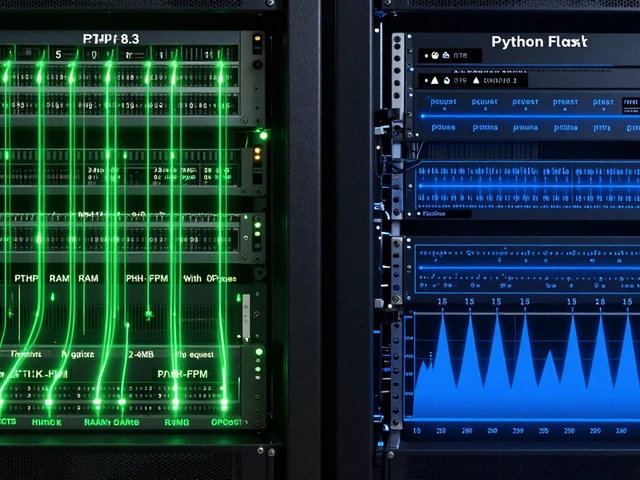


Frontend Language Suitability Analyzer
Select Language
Evaluation Criteria:
- Browser Native Support
- DOM Manipulation Ease
- Performance in Browser
- Ecosystem & Libraries
- Developer Talent Pool
- Learning Curve for Frontend
JavaScript Analysis
RecommendedOverall Score
Excellent for frontend development
Key Factors:
Head-to-Head Comparison
| Feature | JavaScript | Python |
|---|---|---|
| Browser Support | Native | Requires Transpilation |
| DOM Access | Direct API | Glue Code Needed |
| Performance | JIT Optimized | Interpreted/Wasm |
| Ecosystem | npm (2M+ packages) | Limited Frontend Libs |
| Hiring Pool | Massive | Niche |
It feels like a paradox. You have Python, the world's most popular programming language according to recent industry surveys. It is easy to read, incredibly powerful for data science, and dominates backend infrastructure at companies like Instagram and Netflix. Yet, when you look at the code running inside your web browser-the part of the website you actually see and click on-Python is virtually nowhere to be found. Instead, you find JavaScript, a language that many developers admit is quirky, inconsistent, and sometimes frustrating. So why do we accept this? Why does the server run on Python while the browser runs on JavaScript? The answer isn't just about tradition; it is about architecture, history, and how computers actually process instructions.
The Browser Barrier: Why Browsers Only Speak JavaScript
To understand why Python doesn't live in the browser, you first have to understand what the browser actually is. Your web browser-whether it is Chrome, Firefox, or Safari-is not a general-purpose computer operating system. It is a specialized application designed to render web content securely and efficiently.
Decades ago, when Netscape Navigator was king, the engineers needed a way to make static HTML pages interactive. They didn't need a heavy, complex language. They needed something lightweight that could handle simple tasks like form validation or changing an image when hovered over. Enter Mocha, later renamed LiveScript, and finally JavaScript. It was created in just ten days by Brendan Eich in 1995. Because it was built specifically for the browser, the browser vendors baked its engine directly into their software.
This creates a massive moat. To use Python in the browser today, you aren't just writing code; you are fighting the fundamental design of the internet's client-side runtime. Browsers come with a JavaScript engine (like V8 in Chrome) pre-installed. They do not come with a Python interpreter. If you want to run Python, you have to either compile it down to JavaScript or WebAssembly, which adds layers of complexity and performance overhead that native JavaScript simply doesn't have.
The DOM: A Native JavaScript Interface
The biggest technical hurdle for Python is the Document Object Model, or DOM. The DOM is the bridge between your code and the visual elements on the screen. When you click a button, the DOM tells the browser what happened. When you want to change text color, the DOM sends the command.
Here is the catch: the DOM API is defined in terms of JavaScript objects. Every method, every event listener, and every property is designed around JavaScript's syntax and behavior. For example, accessing an element looks like this in JavaScript:
document.getElementById('myButton').addEventListener('click', myFunction);If you try to do this in Python, you face a translation problem. Tools like Brython or Pyodide attempt to map Python syntax to these JavaScript methods. But it is never seamless. You end up writing Python code that feels like JavaScript wearing a disguise. You lose the natural elegance of Python because you are constantly translating concepts that don't align perfectly. JavaScript owns the interface to the user's screen, and that ownership is hard-coded into the standards set by the W3C.
Performance and Compilation Overhead
Let's talk speed. In the early days of computing, interpreted languages were slow. Python is an interpreted language, meaning it reads and executes code line-by-line at runtime. JavaScript used to be the same. However, modern browsers have invested billions of dollars into optimizing JavaScript engines.
Chrome’s V8 engine, for instance, uses Just-In-Time (JIT) compilation. It takes your JavaScript code, compiles it to machine code on the fly, and optimizes it as it runs. This makes modern JavaScript incredibly fast-often faster than interpreted Python.
If you bring Python to the frontend, you have two choices:
- Transpile to JavaScript: Convert Python code to JavaScript before it runs. This works, but you still rely on the JavaScript engine, and the resulting JS can be bloated or inefficient compared to hand-written JavaScript.
- Use WebAssembly (Wasm): Compile Python to Wasm, a binary format that runs near-native speed. This is promising for heavy computation, but Wasm cannot easily access the DOM. You still need JavaScript to act as a glue layer between your Wasm module and the browser interface.
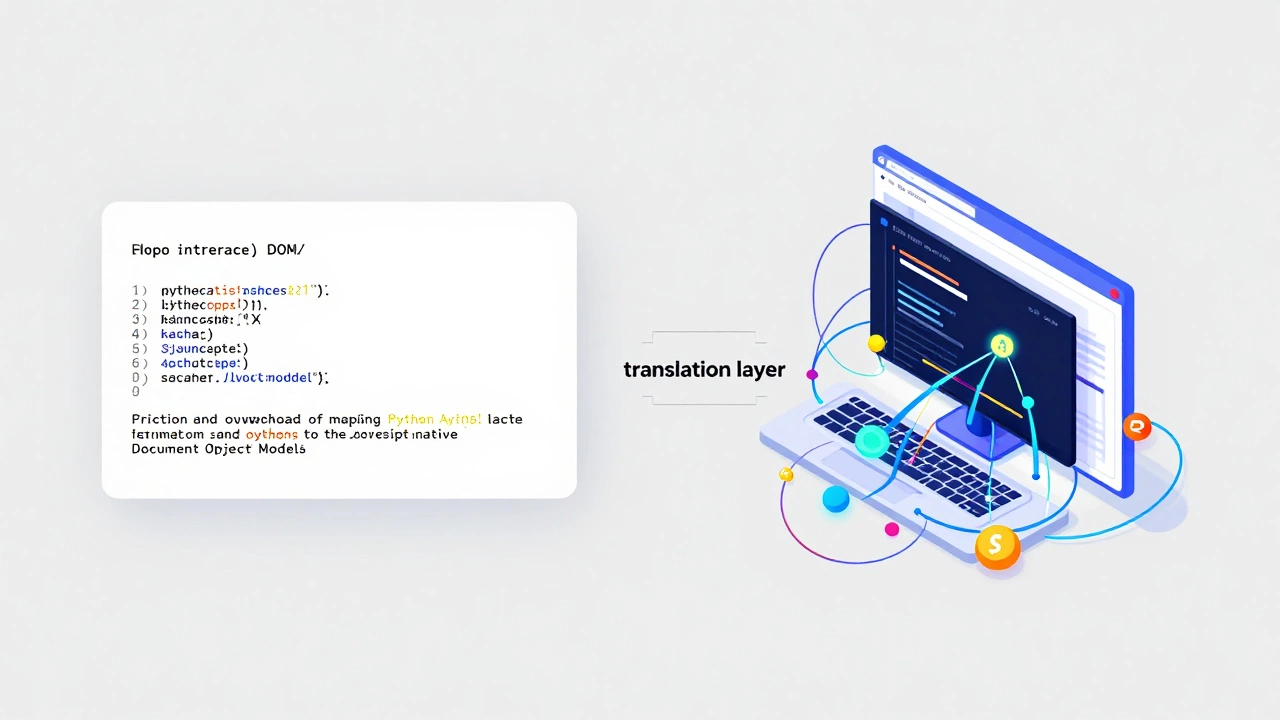
In both cases, you add a step. In software engineering, adding steps usually means adding points of failure and maintenance costs. Why add a translation layer when the target language is already optimized for the environment?
Ecosystem and Tooling: The Network Effect
Technology choices are rarely made on merit alone; they are driven by ecosystem momentum. By the time Python became a serious contender in general-purpose programming, JavaScript had already won the frontend war. The tooling around JavaScript is mature, vast, and deeply integrated.
Consider the package manager. npm (Node Package Manager) hosts over two million packages. If you need a date formatter, a chart library, or a UI component, there is likely an npm package for it. While Python has PyPI, the frontend-specific libraries there are sparse because the community has moved elsewhere.
Then there are the frameworks. React, Vue, and Angular are the pillars of modern frontend development. They are all written in JavaScript (or TypeScript, a superset of JavaScript). They provide virtual DOMs, state management, and routing solutions that are battle-tested by millions of developers. Porting these concepts to Python requires building entirely new frameworks from scratch, which few teams have the resources to maintain.
When you hire a frontend developer in 2026, you expect them to know JavaScript. You might hope they know Python for backend tasks, but expecting them to debug a Python-based frontend using a niche transpiler is unrealistic. The talent pool favors the standard.
When Python *Does* Touch the Frontend
It would be inaccurate to say Python has no place in the frontend conversation. There are scenarios where Python developers prefer to stay in their comfort zone, leading to hybrid approaches.
- Django Templates: In server-side rendering, Django allows you to embed logic in HTML templates. This isn't true frontend interactivity, but it lets Python influence the initial HTML sent to the browser.
- Brython and Pyodide: These projects allow you to write Python that runs in the browser by replacing the JavaScript interpreter. They are great for educational purposes or small prototypes, but they struggle with large-scale applications due to bundle size and performance issues.
- FaaS (Functions as a Service): You can use Python for edge computing functions that generate HTML snippets, which are then injected into the page via JavaScript. This keeps Python off the main thread but still leverages its strengths.
However, these are workarounds. They acknowledge that JavaScript is the lingua franca of the browser and try to minimize the amount of JavaScript you have to write, rather than eliminating it entirely.
| Feature | JavaScript | Python (via Transpilation/Wasm) |
|---|---|---|
| Browser Support | Native, Universal | Requires Polyfills/Compilation |
| DOM Access | Direct, Optimized | Indirect, Glue Code Needed |
| Performance | High (JIT Compiled) | Variable (Overhead Heavy) |
| Ecosystem Size | Vast (npm) | Limited (PyPI Frontend Libs) |
| Hiring Pool | Massive | Niche |

The Rise of TypeScript and Modern Alternatives
If Python is so good, why haven't other languages succeeded in taking over the frontend? Languages like CoffeeScript and Elm tried. They failed to gain mainstream traction because they couldn't overcome the network effect of JavaScript. Today, even Python developers often turn to TypeScript when they need structure. TypeScript adds static typing to JavaScript, solving one of Python's main advantages (type safety) without leaving the JavaScript ecosystem. This further cements JavaScript's dominance, as it evolves to meet the needs that once drove developers toward Python.
Conclusion: Acceptance of Reality
Python is not used for frontend development not because it is a bad language, but because it is the wrong tool for this specific job. The browser is a JavaScript-native environment. Fighting that reality introduces friction, performance penalties, and maintenance headaches. For backend tasks, data processing, and AI, Python reigns supreme. But for the pixels on your screen, JavaScript remains the undisputed king. Understanding this division allows developers to leverage the best of both worlds: Python for power on the server, and JavaScript for precision in the browser.
Can I use Python instead of JavaScript for websites?
Not directly. Browsers only natively support JavaScript. You can use tools like Brython or Pyodide to run Python in the browser, but these tools translate your Python code into JavaScript or WebAssembly under the hood. This adds complexity and potential performance issues, making it impractical for most commercial projects.
Is Python faster than JavaScript?
Generally, no, especially in the browser. Modern JavaScript engines like V8 use Just-In-Time (JIT) compilation, making JavaScript extremely fast. Python is an interpreted language. While Python may be faster for certain CPU-heavy tasks on the server due to optimized libraries (like NumPy), in the context of frontend interactivity and DOM manipulation, JavaScript is significantly more efficient.
What is the role of WebAssembly in Python frontend development?
WebAssembly (Wasm) allows Python code to run at near-native speed in the browser. However, Wasm modules cannot directly manipulate the DOM. You still need JavaScript to act as a bridge between the Wasm module and the browser interface. This makes it useful for heavy computations (like image processing) but not for general UI development.
Why did JavaScript win the frontend war?
JavaScript won because it was the first language embedded in browsers, creating a massive network effect. As more developers learned it, more libraries and frameworks were built for it. Browser vendors also heavily optimized JavaScript engines, ensuring high performance. By the time other languages considered entering the space, JavaScript's ecosystem was too entrenched to displace.
Should I learn Python or JavaScript for web development?
You should learn both if you want to be a full-stack developer. Learn JavaScript for the frontend (what users see) and Python for the backend (server logic, databases, APIs). They complement each other well. Trying to replace JavaScript with Python on the frontend will limit your job opportunities and increase project complexity.