

Full Stack Developer Salary vs. Cost of Living Calculator
Configure Your Scenario
Financial Breakdown: United States
Estimated Monthly Disposable Income
$4,200
Potential annual savings: $50,400
Effective Tax Rate
Net Monthly Income
Cost of Living Index
The US offers the highest gross potential, but high rent and healthcare contributions significantly impact your bottom line compared to European alternatives.
Money talks, especially when you’re juggling backend databases and frontend interfaces all day. If you are a full stack developer, you know that your skills are in high demand globally. But where exactly does that demand translate into the biggest paycheck? The answer isn’t just about picking a random wealthy nation; it’s about understanding the interplay between local cost of living, tax structures, and the specific tech hubs driving the economy.
In 2026, the landscape has shifted significantly from the pandemic-era remote boom. While remote work is still prevalent, companies are increasingly tying compensation to geographic location or offering tiered pay scales based on where you live. This means the "highest salary" title depends heavily on whether you are willing to relocate to a physical office or if you are looking for a fully remote role with global pay parity.
The Global Champions: Where the Money Is
When we look at raw gross annual figures, a few countries consistently dominate the top of the charts. These nations have mature tech ecosystems, high concentrations of venture capital, and a shortage of senior engineering talent that drives wages up.
| Country | Average Base Salary (USD) | Tech Hub | Key Industry Drivers |
|---|---|---|---|
| United States | $145,000 - $180,000+ | Silicon Valley, Seattle, NYC | Big Tech, Fintech, AI Startups |
| Switzerland | $130,000 - $160,000 | Zurich, Geneva | Pharma, Finance, Blockchain |
| Netherlands | $90,000 - $120,000 | Amsterdam | E-commerce, SaaS, Gaming |
| Germany | $85,000 - $115,000 | Berlin, Munich | Automotive Tech, Industrial IoT |
| Canada | $95,000 - $130,000 | Toronto, Vancouver | AI Research, Web Services |
The United States remains the undisputed king of base salaries. In major hubs like San Francisco or Seattle, senior full stack roles often come with total compensation packages exceeding $250,000 when you factor in stock options (RSUs) and bonuses. However, these numbers are skewed by the concentration of mega-corporations. Outside of these bubbles, salaries drop significantly.
Switzerland offers a compelling alternative. With some of the highest minimum wages in the world and a strong Franc currency, developers in Zurich can earn salaries comparable to US counterparts while enjoying better work-life balance and social benefits. The trade-off? A very high cost of living, particularly for housing and health insurance.
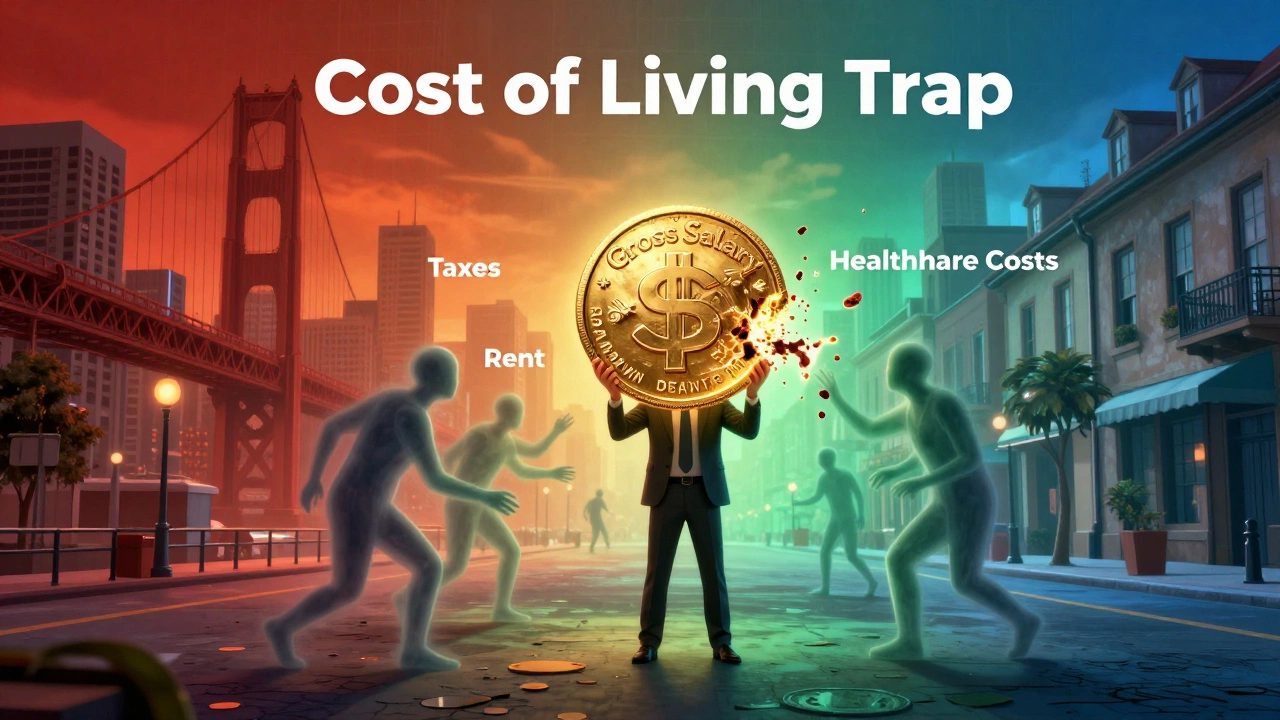
The Cost of Living Trap: Why Gross Salary Isn't Everything
Here is the catch: earning $150,000 in San Francisco doesn’t mean you are richer than someone earning $90,000 in Berlin. You have to calculate your disposable income. This involves subtracting taxes, rent, utilities, and daily expenses from your gross salary.
In the US, healthcare costs can eat up thousands of dollars annually unless your employer provides excellent coverage. In contrast, countries like Germany and the Netherlands have robust public healthcare systems funded through payroll taxes. While your take-home pay might be lower due to higher income tax rates (often 30-40%+), your safety net is stronger, and your out-of-pocket medical expenses are near zero.
Consider this scenario: A full stack developer in Amsterdam earns €95,000. After taxes and social contributions, they take home roughly €5,500 per month. Rent for a nice apartment might be €1,800. They still have €3,700 left for savings and lifestyle. Compare this to a developer in New York earning $120,000. After federal and state taxes, plus Medicare and Social Security, their monthly take-home might be $7,200. But rent for a comparable space could be $3,500, leaving them with $3,700. The disposable income is nearly identical, but the American worker faces higher stress regarding job security and healthcare access.
Remote Work: The Great Equalizer?
The rise of remote work promised to flatten global wage disparities. Initially, many US startups hired developers from Eastern Europe or Southeast Asia at local rates, saving money while providing those workers with life-changing incomes. However, by 2026, the trend has reversed for top-tier talent.
Many leading tech companies now offer "global pay bands." This means if you are hired as a full stack developer by a US-based company, you might receive a salary adjusted for your location, but not necessarily at the low end of the spectrum. Some forward-thinking firms practice "location-independent pay," where everyone earns the same rate regardless of where they sit. These jobs are fiercely competitive because developers worldwide compete for them.
If you are based in a country with a lower cost of living, such as Portugal, Mexico, or India, securing a remote role with a US or Swiss company can yield an incredible quality of life. Your purchasing power parity (PPP) skyrockets. You aren't getting the highest nominal salary, but your ability to save, travel, and enjoy life is maximized.
Emerging Markets and Hidden Gems
While the traditional giants hold the top spots, some emerging markets are catching up fast. Estonia, for instance, has built a digital society from the ground up. Salaries for full stack developers in Tallinn are rising rapidly, averaging around €50,000 to €70,000. While this sounds low compared to the US, the cost of living is moderate, and the government offers e-residency programs that make starting a business incredibly easy. Many developers there combine employment with side projects, boosting their effective income.
Similarly, Singapore continues to attract tech talent with its low personal income tax rates (capped at 22%) and strategic position in Asia. Salaries here range from $80,000 to $120,000 USD equivalent, making it a lucrative option for those who want to be close to Asian markets without dealing with the bureaucratic hurdles of mainland China.
Skills That Command Premiums
Your salary potential also depends on your specific tech stack. Not all full stack developers are paid equally. In 2026, certain combinations of skills command significant premiums:
- AI Integration: Developers who can integrate Large Language Models (LLMs) into web applications using Python, JavaScript, and frameworks like LangChain are seeing 20-30% salary bumps.
- Cloud Native Architecture: Expertise in AWS, Azure, or Google Cloud Platform, combined with Kubernetes and Docker, is non-negotiable for senior roles. Companies pay more for engineers who can design scalable, resilient systems.
- TypeScript & React/Next.js: While JavaScript remains ubiquitous, TypeScript has become the standard for large-scale enterprise applications. Proficiency in modern meta-frameworks like Next.js or Remix is highly valued.
- Rust & Go: For performance-critical backend services, knowledge of Rust or Go is increasingly sought after. These languages are harder to learn, so supply is lower, driving up wages for specialists.

Tax Implications and Visa Considerations
If you are planning to move, don't overlook the legal and financial hurdles. Most countries require a work visa for non-citizens. The US H-1B visa lottery is notoriously difficult to win, making relocation risky. In contrast, countries like Canada (Global Talent Stream), Germany (EU Blue Card), and the Netherlands (Highly Skilled Migrant permit) have streamlined processes for tech workers.
Tax residency rules are complex. If you work remotely for a foreign company while living in another country, you may owe taxes in both places. Double taxation treaties exist to prevent this, but you need professional advice. For example, the US taxes its citizens on worldwide income, even if they live abroad. This can significantly reduce the appeal of moving overseas for Americans.
How to Maximize Your Earnings
So, how do you land one of these high-paying roles? First, tailor your resume to highlight impact, not just technologies. Instead of saying "Used React and Node.js," say "Built a real-time dashboard serving 100k users, reducing load times by 40%." Quantifiable results speak louder than buzzwords.
Second, leverage negotiation. In many European countries, salary negotiation is less common and sometimes frowned upon. In the US and UK, it is expected. Always ask for the salary range upfront. If you have multiple offers, use them as leverage. Recruiters respect candidates who are in demand.
Finally, consider contracting. Freelance full stack developers can often charge hourly rates that exceed salaried equivalents. Platforms like Toptal or Upwork connect you with global clients. However, you lose benefits like paid leave and health insurance, so factor those costs into your rates.
Is the US really the best place for full stack developers financially?
For raw gross salary, yes. The US pays the highest base salaries, especially in tech hubs. However, when factoring in taxes, healthcare costs, and lack of paid vacation, the net benefit decreases. Countries like Switzerland or the Netherlands offer a better balance of high pay and quality of life.
Can I earn a US-level salary while living in Europe?
It is possible but rare. Some US-based startups offer global pay parity, meaning they pay the same rate regardless of location. More commonly, European salaries are adjusted for local market rates, which are lower than US rates but still high relative to the local cost of living.
What tech stack pays the most in 2026?
Full stack developers with expertise in AI integration (Python, LangChain), cloud-native architectures (AWS, Kubernetes), and modern frontend frameworks (React/Next.js with TypeScript) command the highest premiums. Knowledge of Rust or Go for backend performance is also highly valuable.
Which European country has the easiest visa process for developers?
Germany's EU Blue Card and the Netherlands' Highly Skilled Migrant permit are among the most accessible for non-EU developers. Both countries have streamlined processes for tech workers with job offers meeting certain salary thresholds. Canada's Global Talent Stream is also very efficient for North American relocation.
Should I freelance or get a full-time job for higher income?
Freelancing can yield higher hourly rates, but it comes with instability and no benefits. Full-time jobs offer equity, bonuses, and stability. For maximum earnings, many developers start with a stable full-time role and then take on freelance contracts on the side once they have established a client base.