Future-Proof Your Web Dev Career
Are you ready for the next decade of the web? Answer these quick questions to see how well your current skillset aligns with the predicted standards of 2029-2031.
Ready?
Complete the quiz to see your score.
Trend Alignment
Key Recommendation
Imagine building a website where you barely write any code. Instead, you describe the functionality in plain English, and an AI agent scaffolds the entire application, handles database migrations, and deploys it to the edge. Sounds like sci-fi? It’s becoming our reality. The future of web development isn't just about new JavaScript frameworks popping up every six months; it's about a fundamental shift in how we build, deploy, and maintain digital experiences.
If you're a developer today, you might feel overwhelmed by the pace of change. But here is the good news: the chaos is settling into clear patterns. By looking at current adoption rates and infrastructure costs, we can predict with reasonable confidence what your tech stack will look like in five years. This isn't about guessing which library will win the popularity contest. It's about understanding the structural changes that will define the next decade of the web.
The Rise of AI-Assisted Development
Let's start with the elephant in the room: Artificial Intelligence. For years, developers feared AI would replace them. That hasn't happened. Instead, AI has become the most powerful tool in our kit. We are moving past simple autocomplete plugins toward autonomous coding agents. These aren't just suggesting lines of code; they are refactoring entire modules, writing tests, and optimizing performance based on real-time user data.
In the next five years, expect AI to handle the "boring" parts of development. Setting up boilerplate, managing state, and even debugging common errors will be automated. This frees you to focus on architecture, user experience, and business logic. However, this shift demands new skills. You need to know how to prompt effectively, verify AI-generated code for security vulnerabilities, and integrate these tools into your CI/CD pipelines. The developer who masters AI collaboration will outpace those who ignore it.
Edge Computing Becomes Standard
For a long time, centralizing everything in one big cloud server was the norm. But latency kills user experience. Users in London don't want to wait for data from a server in Virginia. Enter edge computing. This technology processes data closer to the user, often within milliseconds.
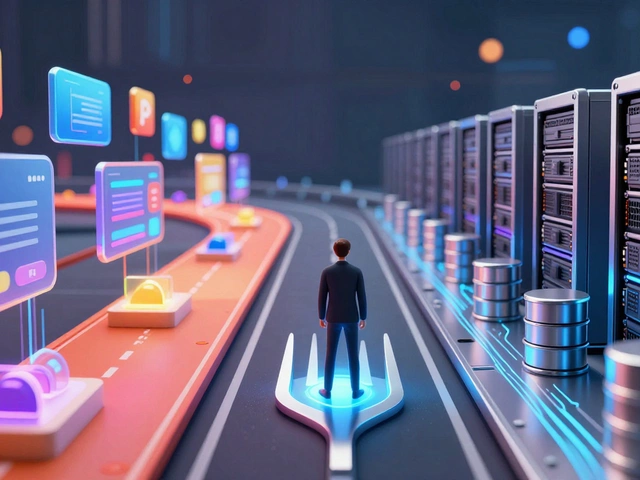
Platforms like Cloudflare Workers and Vercel Edge Functions have made this accessible to everyone, not just tech giants. In five years, running your backend logic at the edge won't be an optimization trick; it will be the default. Why? Because it reduces bandwidth costs and improves speed globally. Static sites are evolving into dynamic applications served from thousands of locations worldwide. If you're still relying solely on traditional monolithic servers hosted in a single region, you're already falling behind.

The Framework Fatigue Ends (Sort Of)
We've all been there: spending weeks learning a new framework, only to see it lose momentum two years later. React, Vue, Angular, Svelte, SolidJS-the list goes on. But the future points toward stability through standardization. Web Components are gaining serious traction as a way to build reusable UI elements that work across any framework.
Instead of rewriting components when switching from React to Vue, you'll use native browser standards. This doesn't mean frameworks die out. They remain excellent for complex state management and routing. But the core UI layer will increasingly rely on standardized HTML and CSS. This reduces bundle sizes and improves long-term maintainability. Companies will prefer solutions that don't lock them into a specific vendor's ecosystem, pushing the industry toward interoperability.
| Feature | Current Trend (2024-2025) | Projected Standard (2029-2031) |
|---|---|---|
| Coding Approach | Manual coding with AI assistance | AI-driven generation with human oversight |
| Hosting | Cloud regions (AWS/GCP) | Global Edge Networks |
| UI Architecture | Framework-specific components | Native Web Components + Frameworks |
| Data Fetching | REST APIs / GraphQL | Server Actions & Streaming Data |
Sustainability Drives Design Choices
Green IT is no longer a buzzword; it's a compliance requirement. As energy costs rise and environmental regulations tighten, bloated websites are becoming liabilities. A heavy site consumes more power during loading and rendering. Developers will need to prioritize efficiency over flashy animations that add little value.
This means smaller JavaScript bundles, optimized images using modern formats like AVIF, and mindful use of third-party scripts. Tools that measure carbon footprint per page view will become as common as Lighthouse audits. If your site loads slowly because of unnecessary bloat, you're not just losing users-you're increasing your operational costs and carbon emissions. Sustainable design is fast design, and that's a win-win.

Security Moves Left
With AI generating code, the risk of subtle security flaws increases. Automated tools are great, but they can hallucinate insecure practices. Therefore, security testing must happen earlier in the development cycle. This concept, known as "shifting left," involves integrating security checks directly into your IDE and commit hooks.
Expect widespread adoption of software composition analysis (SCA) tools that automatically flag vulnerable dependencies before you even push code. Zero-trust architectures will also become standard, even for small projects. Verifying every request, regardless of origin, protects against the growing threat of supply chain attacks. Ignoring security until deployment is a luxury we can no longer afford.
What This Means for Your Career
So, should you panic? Absolutely not. The role of the developer is evolving, not disappearing. You are transitioning from a coder to a product engineer. Your value lies in understanding the problem space, designing robust systems, and guiding AI tools to produce high-quality results. Soft skills-communication, empathy, and strategic thinking-are becoming harder to automate than syntax knowledge.
Stay curious. Experiment with new tools, but don't chase every shiny object. Focus on fundamentals: HTTP protocols, network performance, accessibility, and clean architecture. These principles remain constant even as the tools change. The developers who thrive in the next five years will be those who adapt quickly while keeping their feet firmly planted in solid engineering practices.
Will AI replace web developers?
No, AI will not replace developers entirely. Instead, it will augment their capabilities, automating repetitive tasks and allowing humans to focus on complex problem-solving, architecture, and user experience. Developers who learn to leverage AI tools effectively will likely see increased productivity rather than job loss.
Is React still worth learning in 2026?
Yes, React remains highly relevant due to its massive ecosystem and job market demand. While Web Components offer long-term stability, React continues to dominate enterprise-level applications. Learning React alongside emerging standards ensures versatility in your career.
What is edge computing in simple terms?
Edge computing processes data closer to the user instead of sending it to a distant central server. This reduces latency, making websites load faster and respond quicker, especially for global audiences. It is becoming the preferred hosting model for performance-critical applications.
How does sustainability affect web development?
Sustainable web development focuses on reducing the energy consumption of websites. This involves optimizing code size, minimizing image weights, and efficient data transfer. As environmental regulations tighten, companies are prioritizing green metrics alongside performance scores.
Do I need to learn multiple programming languages?
While specializing in one area is beneficial, knowing multiple languages increases flexibility. For web development, proficiency in JavaScript/TypeScript is essential. Understanding backend languages like Python or Go, along with SQL, makes you a more well-rounded full-stack developer capable of handling diverse project requirements.