
PHP vs JavaScript Project Advisor
Answer the questions below to get a personalized recommendation on which language to learn first.
Walk into any local meet-up in Leeds or scroll through a junior developer forum, and you'll hear the same debate: PHP is dead, long live JavaScript. But here's the twist-millions of websites still run on PHP, and JavaScript powers almost everything else. So, which one is actually easier to learn? If you're staring at two blank screens, wondering where to start your coding journey, the answer isn't as simple as "one is better." It depends entirely on what you want to build.
The Core Difference: Server-Side vs. Client-Side
To understand difficulty, you first need to grasp where these languages live. PHP is a server-side scripting language designed specifically for web development. You write code that runs on the server, processes data, talks to databases, and sends HTML back to the browser. The user never sees the PHP code; they only see the result.
JavaScript, originally a client-side scripting language, now runs everywhere thanks to Node.js. Traditionally, it lives in the browser, making pages interactive-think dropdown menus, animations, or form validation without reloading the page.
Why does this matter for difficulty? With PHP, you get immediate feedback from the server. If you make a mistake, the server often throws a clear error message before sending anything to the browser. With JavaScript, especially when debugging complex front-end interactions, tracking down why a button click didn't trigger an API call can feel like hunting for a needle in a haystack. For beginners, that clarity in PHP can be a massive relief.
Syntax and Structure: Who Plays Nicely?
Let's look at the actual code. Both languages share C-style syntax, so if you know one, the other feels familiar. But there are subtle traps.
In PHP, variables always start with a dollar sign ($). This makes them visually distinct. In JavaScript, you declare variables using `let`, `const`, or the older `var`. For a newcomer, seeing `$name = "Caden";` is unambiguous. Seeing `name = "Caden";` in JavaScript might leave you wondering: did I forget to declare it? Did I accidentally create a global variable? These small syntactic differences add cognitive load.
However, PHP has its own quirks. Its standard library is inconsistent. Some functions use underscores (`str_replace`), others don't (`strlen`). Some return arrays, others return strings. JavaScript’s ecosystem, particularly modern ES6+, offers more consistency in how objects and arrays are handled. Yet, PHP’s inconsistency is predictable once you memorize the patterns. JavaScript’s dynamic typing can lead to unexpected type coercion bugs-like adding a string to a number and getting concatenation instead of addition-which frustrates beginners who expect math.
Setup and Environment: The Friction Factor
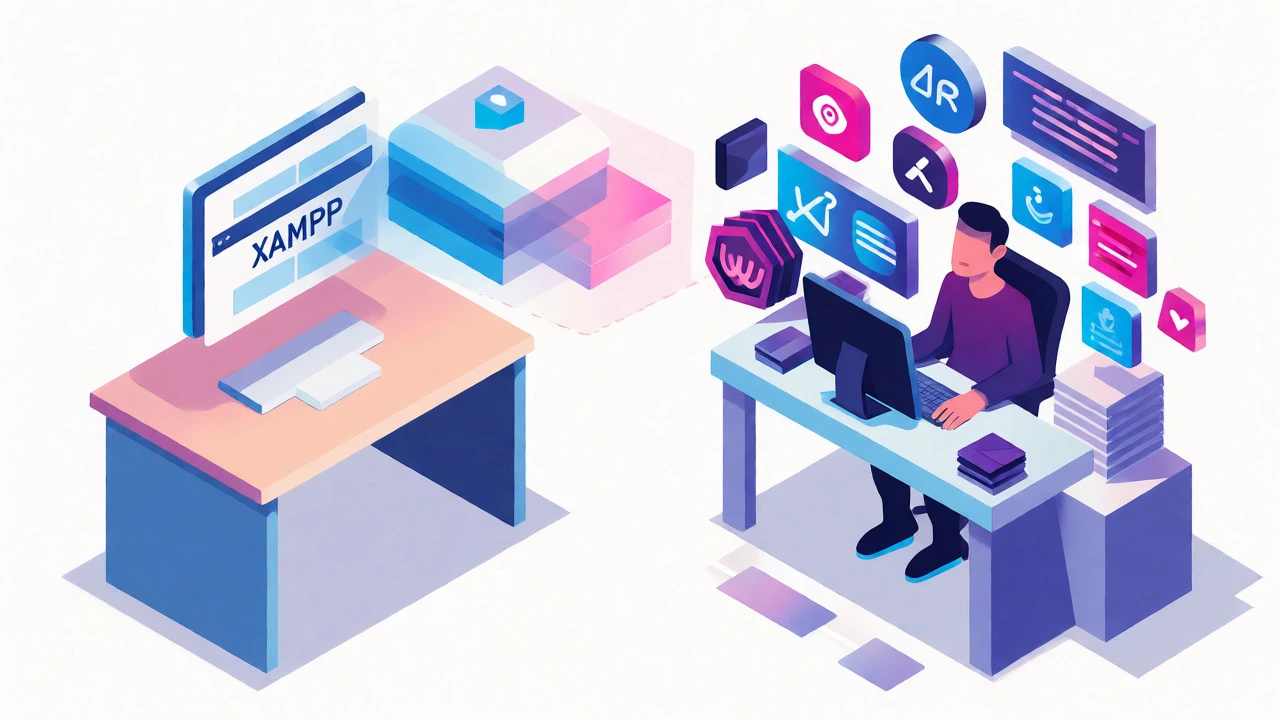
This is where PHP often wins for absolute beginners. To run a basic PHP script, you need a server environment. Tools like XAMPP or MAMP bundle Apache, MySQL, and PHP into a single installer. Double-click, install, and you have a working local server. Write a file named `index.php`, drop it in the folder, refresh your browser, and boom-you’re running code.
JavaScript requires no installation for basic browser scripts. Just open Chrome DevTools console and type `console.log("Hello")`. But real-world JavaScript development involves setting up a project structure, installing dependencies via npm (Node Package Manager), configuring bundlers like Webpack or Vite, and understanding module systems. For someone just starting out, this tooling overhead is intimidating. You spend hours fighting configuration files before writing meaningful logic.
| Feature | PHP | JavaScript |
|---|---|---|
| Initial Install | Single package (XAMPP/MAMP) | None for browser; Node.js + npm for dev |
| Dependency Management | Composer (simple JSON config) | npm/yarn (complex node_modules) |
| Debugging Tools | Browser view-source + server logs | Chrome DevTools (powerful but complex) |
| Hosting Cost | Very cheap shared hosting | Varies; static hosts free, servers cost more |
The Learning Curve: Where Do People Quit?
Anecdotal evidence from coding bootcamps suggests PHP has a lower barrier to entry for building full applications. Why? Because PHP handles the boring stuff well. Need to connect to a database? PHP has built-in extensions like PDO that make SQL queries straightforward. Need to send an email? One function call. Need to handle form submissions? The superglobal `$_POST` array gives you the data instantly.
JavaScript, by contrast, forces you to think about asynchronous behavior early on. Handling HTTP requests, managing state, and dealing with promises or async/await syntax adds layers of complexity. A beginner trying to fetch data from an API in JavaScript must understand callbacks, then promises, then async/await. In PHP, you just use `file_get_contents()` or cURL synchronously. The mental model is linear: do step A, then step B, then step C. No waiting, no race conditions.
But wait-is synchronous always better? Not necessarily. Modern users expect fast, responsive interfaces. JavaScript excels here because it doesn’t block the main thread. PHP blocks until the server finishes processing. So while PHP is easier to *write* initially, JavaScript is harder to *master* because it demands understanding concurrency and event loops.
Ecosystem and Job Market: What Pays the Bills?
Learning a language is an investment. You want to know if it leads to work. PHP dominates the content management system world. WordPress alone powers over 40% of the internet. If you want freelance work building blogs, small business sites, or e-commerce stores with WooCommerce, PHP is king. The jobs are plentiful, though often lower-paid than enterprise-level roles.
JavaScript is ubiquitous. It’s required for front-end frameworks like React, Vue, and Angular. It’s essential for full-stack roles using Node.js. The demand for JavaScript developers is higher, and salaries tend to be higher too, especially in tech hubs like London or remote-first companies. However, the competition is fiercer. Everyone learns JavaScript. Fewer people stick with PHP because it lacks the "cool factor" among new developers.
If you aim for quick freelance gigs, PHP gets you there faster. If you want a career at a tech startup or big tech firm, JavaScript is non-negotiable.

Real-World Scenarios: Which Tool Fits?
Imagine you want to build a personal portfolio site with a contact form. PHP is simpler. You write a few lines of code to validate input and send an email. Done. No build steps, no framework bloat.
Now imagine you’re building a social media dashboard where posts update in real-time without refreshing. PHP struggles here. You’d need to poll the server repeatedly, wasting resources. JavaScript shines with WebSocket connections and reactive UI updates. Trying to force PHP into this role results in messy, unmaintainable code.
Consider Laravel for PHP. It’s a robust framework that adds structure, routing, and ORM capabilities. It reduces boilerplate significantly. Compare that to Express.js for Node. Express is minimalistic; you choose your own database driver, templating engine, and auth strategy. This flexibility is powerful but overwhelming for beginners. Laravel guides you; Express lets you wander.
The Verdict: Is PHP Actually Easier?
For building traditional, content-driven websites, yes, PHP is generally easier to learn and deploy. Its setup is simpler, its error messages are clearer, and its synchronous nature matches how beginners naturally think about problem-solving. You can go from zero to a functional blog in a weekend.
JavaScript is harder to master due to its asynchronous nature, complex tooling, and vast ecosystem fragmentation. But it’s indispensable for modern interactive web experiences. Once you cross the initial hurdle, JavaScript opens doors to mobile apps (React Native), desktop apps (Electron), and serverless architectures.
Don’t fall for the trap of thinking you must choose one forever. Most professional developers use both. They use PHP for the backend logic and database interactions, and JavaScript for the frontend interactivity. The question isn’t "which is easier?" but "which solves my current problem with the least friction?" Start with PHP if you want to build complete websites quickly. Switch to JavaScript when you need rich, app-like interfaces. Or better yet, learn both-they complement each other perfectly.
Can I learn JavaScript without knowing PHP?
Absolutely. JavaScript is completely independent of PHP. You can become a proficient front-end developer knowing only HTML, CSS, and JavaScript. Many developers specialize exclusively in the front end and never touch PHP. However, understanding basic backend concepts helps when integrating APIs.
Is PHP still relevant in 2026?
Yes, PHP remains highly relevant. While newer languages like Go or Python compete in specific niches, PHP’s dominance in CMS platforms like WordPress, Drupal, and Magento ensures steady job demand. Frameworks like Laravel continue to evolve, keeping the language modern and secure.
Which language pays more, PHP or JavaScript?
Generally, JavaScript developers earn higher salaries, particularly those skilled in modern frameworks like React or Node.js. However, senior PHP developers with expertise in Laravel or Symfony can command comparable rates, especially in agency settings or legacy enterprise maintenance roles.
Do I need to learn both to be a full-stack developer?
Not necessarily. Full-stack means handling both client and server sides. You could be full-stack with JavaScript only (using Node.js for the backend) or with Python (Django/Flask) plus JavaScript. However, many job postings explicitly require PHP knowledge alongside JavaScript, especially in mid-sized companies maintaining existing web properties.
Is debugging PHP harder than JavaScript?
It depends on the context. PHP errors are often fatal and stop execution immediately, providing clear line numbers. JavaScript errors can be silent or occur asynchronously, making them harder to trace. However, browser-based debugging tools for JavaScript are far superior to typical PHP debuggers unless you set up advanced IDE integration like Xdebug.