

Every time someone asks me if being a full stack developer is stressful, I think about the last time I spent 14 hours straight fixing a bug that only showed up on Safari iOS 17.3.1 on an old iPad Mini. It wasn’t the bug that stressed me out-it was knowing I had to fix it before the client’s launch, while also updating the API endpoint, reviewing two pull requests, and preparing a demo for the product team. That’s the reality for a lot of full stack developers. It’s not just coding. It’s juggling systems, teams, and expectations-all at once.
What Does a Full Stack Developer Actually Do?
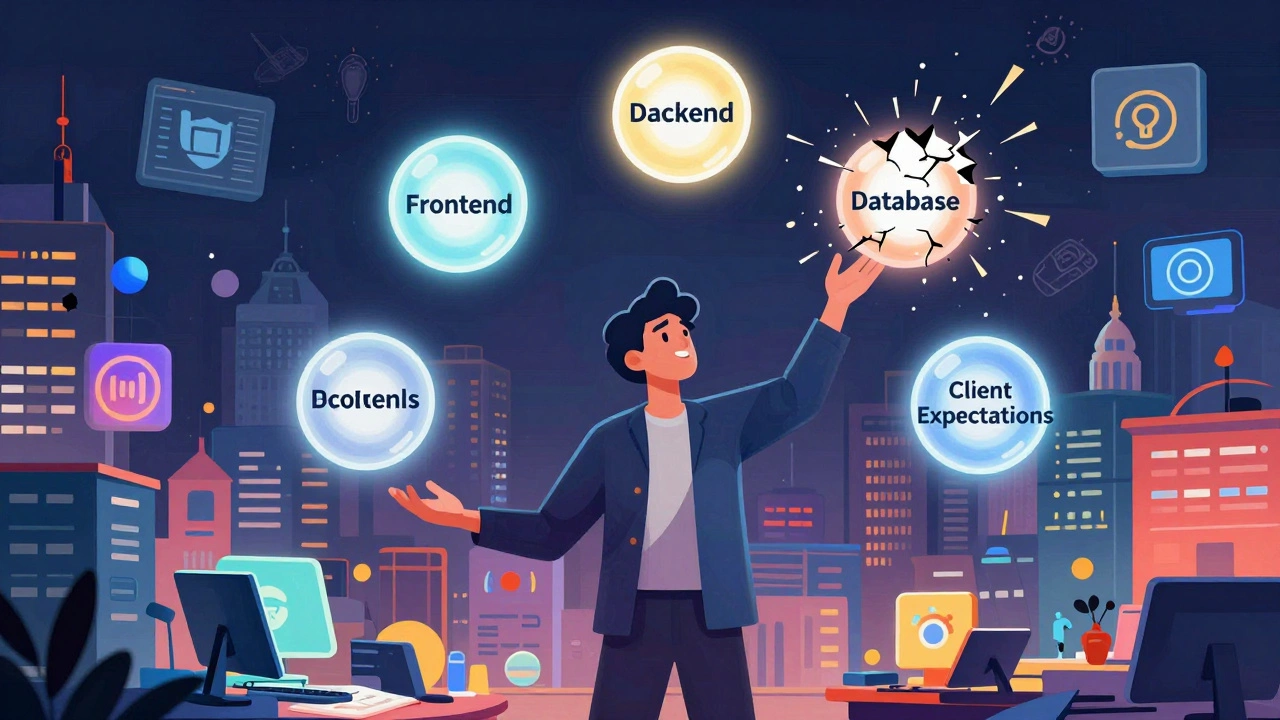
A full stack developer isn’t just someone who knows both frontend and backend. They’re the glue between design, functionality, and infrastructure. On Monday, they might be tweaking CSS animations for a new landing page. By Wednesday, they’re setting up Docker containers for deployment. By Friday, they’re debugging a database timeout that’s slowing down checkout for 20,000 users.
The role covers everything from user interface to server logic. Frontend? HTML, CSS, JavaScript, React, or Vue. Backend? Node.js, Python, Ruby, or Java. Databases? PostgreSQL, MongoDB, or MySQL. DevOps? CI/CD pipelines, cloud hosting on AWS or Azure, monitoring tools like Sentry or Datadog. And don’t forget the APIs, authentication, security patches, and performance tuning.
It’s not that one part is harder than the other-it’s that you’re expected to be competent across all of them. No one’s asking you to be a database architect or a UX designer. But when the front end breaks because the backend returned malformed JSON, you’re the one who has to fix it. And you’re expected to do it fast.
Why the Stress Builds Up
Stress doesn’t come from writing code. It comes from the pressure of being the go-to person for everything.
Startups love full stack developers because one person can cover three roles. Small agencies hire them because they can’t afford separate frontend, backend, and DevOps engineers. Even bigger companies use them as emergency responders when a project falls behind.
Here’s what adds up:
- Constant context switching-you’re not deep in one problem for hours. You’re jumping between UI tweaks, server configs, and database queries.
- Blame culture-when something breaks, the user doesn’t care if it’s the frontend or the API. They see a broken button. You’re the fixer.
- Outdated tools-many companies still run legacy systems. You might be using React 17 while the backend is stuck on Node 12. Maintaining compatibility is a full-time job.
- Unclear requirements-clients or product managers often say, “Can you just make it faster?” without knowing what “faster” means. You’re expected to guess.
- On-call duties-if you’re the only developer, you’re also the one getting paged at 2 a.m. when the server crashes.
A 2024 Stack Overflow survey found that 68% of full stack developers reported feeling overwhelmed at least once a week. That’s higher than frontend-only or backend-only roles. Why? Because they’re the ones holding the whole system together.
It’s Not All Bad-Here’s Where It Gets Easier
Not every full stack job is a pressure cooker. Some companies get it right.
At a well-run tech team, full stack developers aren’t expected to do everything alone. They work with dedicated QA engineers, DevOps specialists, and product designers. The workload is shared. Tools are modern. Documentation exists. You’re not the only person who knows how the system works.
Some developers thrive in this role because they like variety. They don’t want to spend all day writing SQL queries or tweaking CSS. They like the puzzle of connecting pieces across layers. For them, the challenge is energizing, not exhausting.
Companies that invest in automation-automated testing, CI/CD, infrastructure as code-make the job far less stressful. If your deployment process takes less than five minutes and you can roll back with one click, you’re not panicking every time you push code.
And let’s not forget: many full stack developers work remotely or have flexible hours. You can take a walk during lunch. You can pause to pick up your kid from school. That flexibility can balance out the pressure.
Who Should Avoid This Path?
If you hate uncertainty, this isn’t the job for you. If you need clear boundaries-like “I only do frontend, and backend is someone else’s problem”-you’ll burn out.
People who get stressed by constant change, unclear priorities, or being the last line of defense should look elsewhere. Junior developers who jump into full stack roles too early often crash hard. They don’t have the experience to troubleshoot a database connection issue while also explaining to a non-technical stakeholder why the login page is slow.
And if you’re working in a company where “full stack” means “do everything with no support, no time, and no raises”-run. That’s not a career. That’s exploitation.
How to Reduce the Stress
You don’t have to suffer to be a full stack developer. Here’s what actually works:
- Specialize within the stack-you don’t have to be great at everything. Become really strong in one area (like React or Node) and decent in the rest. Depth beats breadth.
- Automate everything-if you’re doing the same task twice, script it. Use linting, testing, and deployment tools. Save your brain for problems that matter.
- Set boundaries-say no to last-minute changes. Block time for deep work. Don’t check Slack after 7 p.m. unless it’s an actual emergency.
- Document everything-if you’re the only one who knows how the system works, you’re a single point of failure. Write it down. Even if it’s just a Notion page.
- Ask for help-you’re not a superhero. If you’re stuck, say so. A senior engineer, a DevOps person, or even a junior teammate can help you move faster.
One developer I know in Leeds started tracking his time. He realized he spent 40% of his week on meetings and firefighting. He pushed back. He got a junior dev to handle basic bug fixes. His stress dropped 60% in two months.

Is It Worth It?
Yes-if you choose the right environment.
Full stack developers are in high demand. Salaries in the UK average £55,000-£85,000 depending on experience. The flexibility is real. You can work remotely, freelance, or move between industries-healthcare, fintech, education, even gaming.
The stress comes from bad systems, not the role itself. A full stack developer in a healthy team has autonomy, respect, and room to grow. A full stack developer in a broken company is a human patch cable.
Ask yourself: Do I want to solve complex problems across layers? Do I enjoy learning new tools? Do I have the support to do it without burning out? If the answer is yes, then go for it. If the answer is no, there are plenty of other tech roles that don’t require you to be everything to everyone.
Being a full stack developer isn’t inherently stressful. But letting a company treat you like a Swiss Army knife without giving you the tools to use it properly? That’s where the pain starts.
Frequently Asked Questions
Is full stack development harder than specializing in one area?
It’s not necessarily harder-it’s different. Specializing lets you go deeper into one area, like mastering React or optimizing PostgreSQL queries. Full stack means you’re spread thin across many areas. If you like variety and learning new things, you’ll enjoy it. If you prefer deep expertise and fewer context switches, specialization is less overwhelming.
Can you be a full stack developer without knowing DevOps?
You can start without it, but you’ll hit a wall fast. Modern development means deploying code, managing servers, and handling errors in production. Even if you’re not running Kubernetes yourself, you need to understand Docker, cloud platforms, and basic monitoring. Most companies expect full stack devs to handle deployment, even if they don’t manage the infrastructure full-time.
Do full stack developers get paid more than specialists?
In the UK, senior full stack developers earn about the same as senior specialists-sometimes slightly more. But the real advantage is flexibility. Full stack developers can move between roles, industries, and companies more easily. Specialists often earn more at top-tier tech firms, but full stack devs have more options overall.
Is burnout common among full stack developers?
Yes, especially in startups or small teams where one person handles everything. A 2024 survey by Stack Overflow found that full stack developers report higher levels of burnout than frontend or backend-only roles. The key is having boundaries, support, and automation. Without those, burnout is almost guaranteed.
What’s the best way to start as a full stack developer without getting overwhelmed?
Start with one stack: pick a frontend framework (like React) and a backend language (like Node.js or Python). Build small projects that connect them-like a to-do app with a database. Don’t try to learn everything at once. Focus on one layer at a time. Join a team where you can learn from others. Avoid jobs that expect you to know AWS, Docker, Kubernetes, React, Vue, TypeScript, and GraphQL on day one.
Next Steps If You’re Considering This Path
If you’re thinking about becoming a full stack developer, start by building something simple. A blog with user comments. A weather app that pulls data from an API. Get comfortable connecting frontend to backend. Then, look for junior roles where you’ll be supported-not expected to fix everything alone.
Ask potential employers: “Who handles deployments?” “Is there a DevOps team?” “How do you handle on-call duties?” If they say, “We don’t have one-we expect you to do it,” walk away.
Full stack development can be rewarding. But only if you’re not alone in the trenches.