

Web Developer Salary Estimator (No Degree)
Your Profile
Estimated Annual Base Salary
Degree Impact: High
Key Factor: Proving you can do the work
You don’t need a four-year computer science degree to build websites that pay the bills. In fact, the tech industry is one of the few sectors where your ability to code often outweighs your diploma. But if you’re skipping college, you might be wondering: is it actually worth it? How much money can you realistically make as a self-taught or bootcamp-trained web developer is a professional who builds and maintains websites and web applications using various programming languages and frameworks without a traditional degree?
The short answer is: plenty. The long answer depends on your skills, your location, and how aggressively you market yourself. Let’s break down the real numbers, the paths to get there, and why employers are hiring people like you right now.
The Salary Reality Check: Numbers Don’t Lie
First, let’s talk cash. According to data from the U.S. Bureau of Labor Statistics and major job boards like Indeed and Glassdoor, the average base salary for a web developer in the United States hovers around $85,000 to $95,000 per year. However, this average includes everyone from entry-level juniors to senior architects at FAANG companies.
If you enter the field without a degree, your starting point will likely be lower, but the ceiling is just as high. Here is what the landscape looks like in 2026:
- Entry-Level (0-2 years): Expect between $55,000 and $75,000. This is where most bootcamp grads and self-taught devs start. You’re proving you can do the work, not that you studied theory.
- Mid-Level (3-5 years): Salaries jump to $80,000 - $110,000. At this stage, your degree doesn’t matter anymore; your track record does.
- Senior/Lead (5+ years): $120,000 - $160,000+. Here, leadership, system design, and business impact dictate your pay.
Keep in mind that geography plays a huge role. A junior dev in San Francisco or New York might start at $90,000 due to the cost of living, while someone in a mid-sized city like Austin or Denver might start at $65,000 with a much better quality of life. Remote work has blurred these lines, but many companies still adjust salaries based on where you live.
| Experience Level | Typical Salary Range | Degree Impact |
|---|---|---|
| Entry-Level | $55k - $75k | High (Degree helps get past HR filters) |
| Mid-Level | $80k - $110k | Low (Portfolio and experience dominate) |
| Senior | $120k - $160k+ | Negligible (Results speak for themselves) |
Why Employers Are Dropping the Degree Requirement
For decades, a Computer Science (CS) degree was the golden ticket. Today, it’s becoming optional. Why the shift? The tech industry moves too fast for universities to keep up. A CS curriculum often focuses on theoretical algorithms and legacy systems, while the market demands proficiency in modern frameworks like React, Vue, or Next.js.
Companies like Google, Apple, IBM, and Tesla have publicly dropped their degree requirements for many technical roles. They realized they were missing out on talented candidates who learned through practice rather than lecture halls. When you hire a non-degree holder, you’re betting on their ability to learn and solve problems, not their ability to pass exams.
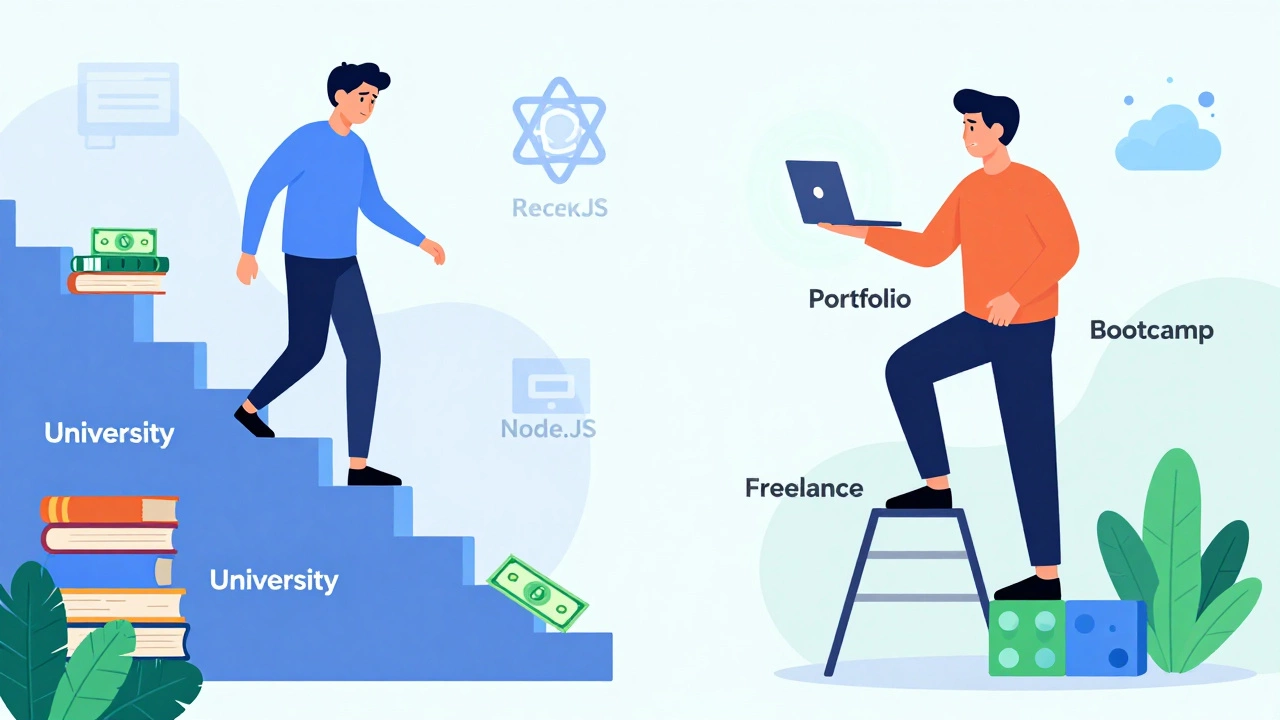
This shift benefits you because it lowers the barrier to entry. Instead of spending four years and $100,000+ in tuition, you can spend six months to two years learning practical skills and entering the workforce debt-free. That financial head start is significant.
The Paths to Getting Hired: Bootcamps vs. Self-Taught
If you aren’t getting a degree, you need a structured way to learn. There are two main roads: coding bootcamps and self-study. Both work, but they require different approaches.
Coding Bootcamps offer an immersive, fast-track education. Programs typically last 12 to 24 weeks and cost between $10,000 and $20,000. The benefit is structure, mentorship, and career services. Many bootcamps have partnerships with hiring companies, which can help bypass the initial resume screen. Look for accredited programs with strong job placement rates (aim for 80%+ within six months).
Self-Taught Developers take the DIY route. You use free resources like freeCodeCamp, The Odin Project, or YouTube tutorials. This path costs almost nothing but requires immense discipline. It can take anywhere from six months to two years to reach job-ready status. The challenge here isn’t learning to code-it’s building a portfolio that proves you’re employable without a teacher holding your hand.
Which is better? If you struggle with procrastination, a bootcamp provides the accountability you need. If you’re budget-conscious and highly motivated, self-teaching saves you thousands. Either way, the goal is the same: build projects that solve real problems.
Your Portfolio Is Your New Diploma
In the absence of a degree, your portfolio is your most powerful asset. It’s not enough to show off a To-Do list app or a weather widget. Employers want to see complexity, scalability, and real-world application.
Here’s what makes a portfolio stand out in 2026:
- Full-Stack Projects: Show you can handle both frontend (what users see) and backend (data storage and logic). Build a clone of a popular service like Trello or Airbnb, but add unique features.
- Open Source Contributions: Contributing to existing projects on GitHub shows you can read other people’s code and collaborate in a team environment. This is a huge signal to hiring managers.
- Live Deployments: Don’t just host code on GitHub. Deploy your apps using Vercel, Netlify, or AWS so recruiters can click and interact with them.
- Case Studies: Write brief explanations of each project. What problem did you solve? What technologies did you use? What challenges did you face? This demonstrates communication skills, which are critical for developers.
Remember, a portfolio isn’t a gallery of perfect code. It’s evidence of your problem-solving process. If you can explain why you chose a certain database or how you optimized a slow-loading page, you’ll beat a candidate with a degree but no practical insight.
Freelancing: The Fast Track to Higher Earnings
One advantage of not having a degree is flexibility. Many non-degree holders start as freelancers before landing full-time jobs. Platforms like Upwork, Fiverr, and Toptal allow you to charge hourly rates or fixed prices for projects.
Freelance rates vary widely. Beginners might charge $20-$50 per hour, while experienced freelancers with niche skills (like Shopify customization or WordPress plugin development) can command $100-$200 per hour. The key is specialization. Generalists compete on price; specialists compete on value.
Freelancing also teaches you soft skills that employers love: client management, scope negotiation, and deadline adherence. These experiences make you a more attractive candidate when you eventually apply for salaried positions.

Overcoming the "No Degree" Bias
While progress has been made, some companies-especially large enterprises or government contractors-still prefer degree holders. This isn’t always about skill; it’s often about risk mitigation and automated HR filters.
To overcome this bias:
- Network Aggressively: Apply through referrals whenever possible. A recommendation from a current employee bypasses HR filters entirely. Attend local meetups, hackathons, and online communities like Discord servers dedicated to web development.
- Target Startups: Smaller companies care less about credentials and more about whether you can hit the ground running. They move fast and need builders, not theorists.
- Get Certified: While not a replacement for a degree, certifications from cloud providers like AWS, Google Cloud, or Microsoft Azure add credibility. They show you understand infrastructure and security, which are high-value skills.
- Master the Interview: Technical interviews often include coding challenges (LeetCode-style) or system design questions. Practice these relentlessly. If you can crush the whiteboard test, your educational background becomes irrelevant.
Long-Term Career Growth Without a Degree
Will lacking a degree hurt you later in your career? Generally, no. After five to ten years, your reputation, network, and body of work define you. Many CTOs and engineering managers never completed a CS degree. They climbed the ladder by delivering results and mentoring others.
However, if you ever decide to pivot into roles that require deep theoretical knowledge-like machine learning engineering or advanced cryptography-you might find gaps in your foundation. In those cases, targeted courses or even returning to school part-time can fill those holes. But for standard web development, continuous learning through blogs, documentation, and conferences is sufficient.
The tech industry rewards adaptability. As long as you stay curious and keep updating your skills, your lack of a diploma will fade into irrelevance. Focus on building, shipping, and solving problems. The money will follow.
Can I get a job at a big tech company without a degree?
Yes, many large tech companies like Google, Apple, and Amazon have removed degree requirements for many software engineering roles. However, competition is fierce. You will need a strong portfolio, excellent performance in technical interviews, and often referrals to get noticed. Focus on mastering data structures and algorithms, as these are heavily tested in big tech interviews.
Is a coding bootcamp worth the cost?
It depends on your learning style and financial situation. Bootcamps provide structure, mentorship, and career support, which can speed up your entry into the job market. If you struggle with self-discipline or need networking opportunities, the $10,000-$20,000 investment can yield a high return. However, if you are highly motivated and resourceful, free online resources can achieve similar results for a fraction of the cost.
What skills should I prioritize if I don't have a degree?
Focus on practical, in-demand skills. For frontend development, master HTML, CSS, JavaScript, and a framework like React or Vue. For backend, learn Node.js, Python, or Ruby along with databases like PostgreSQL or MongoDB. Additionally, learn Git for version control and basic DevOps tools like Docker. Building full-stack projects that integrate these technologies demonstrates versatility and readiness for real-world tasks.
How important is networking for non-degree developers?
Networking is crucial. Without a university alumni network, you must build your own connections. Attend local tech meetups, contribute to open-source projects, and engage on platforms like LinkedIn and Twitter. Referrals are one of the most effective ways to bypass HR screening processes and land interviews. Many jobs are filled through internal recommendations before they are even posted publicly.
Will AI replace web developers without degrees?
AI tools like GitHub Copilot are changing how we code, but they are not replacing developers. Instead, they are augmenting our abilities. Developers who learn to leverage AI for efficiency will thrive. The demand for humans who can architect systems, understand user needs, and debug complex issues remains high. Your ability to think critically and solve business problems is more valuable than rote coding skills.