


JavaScript Math Requirement Checker
Picture this: you’re sitting at your desk, staring at a tutorial on JavaScript is a versatile programming language used to create interactive effects within web browsers. The instructor types out a line of code involving a loop and a variable increment. Suddenly, your brain freezes. Is this algebra? Do I need to remember the quadratic formula from high school? Can I even code if I failed geometry?
If that panic feels familiar, you are not alone. For years, there has been a persistent myth in the tech world that programming is reserved for mathematical geniuses. People assume that to write code, you must be able to derive integrals or calculate complex trigonometric functions in your head. The reality is significantly different. While math plays a role in computer science, everyday JavaScript development relies far more on logic, pattern recognition, and problem-solving than on advanced arithmetic.
The Myth of the "Math Whiz" Programmer
Where does this idea come from? It likely stems from the early days of computing when programmers had to manually manage memory addresses and perform low-level calculations. Today, especially with high-level languages like JavaScript is an interpreted language designed for creating network-aware applications., the heavy lifting is done by the engine. You don't need to know how the engine calculates the position of an element on a screen; you just tell it where you want it to go.
Most professional developers do not use calculus, statistics, or linear algebra in their daily jobs. If you are building a website, a dashboard, or a mobile app interface, your primary tools are conditionals (if/else statements), loops, and data structures. These concepts rely on logical reasoning-similar to following a recipe or organizing a closet-rather than numerical computation. You might ask yourself, "If I can figure out the most efficient route to work avoiding traffic, can I code?" The answer is yes. That ability to plan steps and anticipate outcomes is the core of programming logic.
What Kind of Math Actually Matters?
This doesn't mean numbers are irrelevant. Basic arithmetic is essential. You will frequently add, subtract, multiply, and divide values. However, this is elementary school level math. Let’s look at common scenarios where numbers appear in Web Development involves the work involved in developing a website for the Internet or an intranet.:
- Calculating Totals: In an e-commerce project, you might sum up the price of items in a shopping cart. This requires simple addition and multiplication. You don’t need to derive the formula; you just apply it.
- Modulo Operations: You might use the modulo operator (
%) to determine if a number is even or odd, or to cycle through a list of images. This is basic division with a remainder check. - Indexing Arrays: Computers start counting at zero. Understanding that the first item is at index 0, the second at index 1, and so on, is a conceptual shift, not a mathematical calculation.
Even when dealing with dates, times, or coordinates, libraries like Moment.js is a JavaScript library for parsing, validating, manipulating, and formatting dates. or native Date objects handle the complex leap-year calculations and timezone conversions for you. Your job is to structure the data correctly, not to compute the seconds in a year manually.
Logic vs. Mathematics: The Core Difference
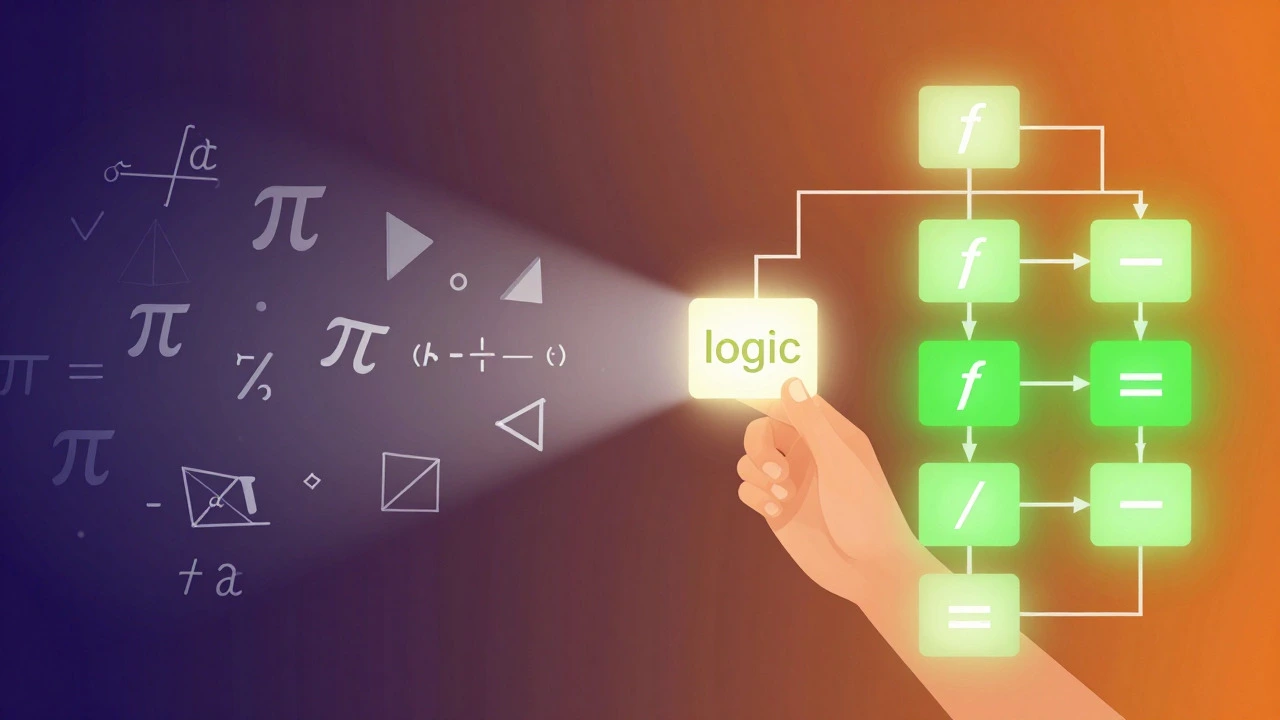
To understand why you don’t need advanced math, we must distinguish between mathematics and logic. Mathematics deals with quantities, structures, space, and change. Logic deals with validity, truth values, and inference. Programming is fundamentally about logic.
Consider a simple feature: showing a "Sale" badge only if the discount is greater than 20%. In code, this looks like:
if (discount > 20) {
  showBadge();
}
This is a boolean logic statement. It evaluates to true or false. There is no complex equation here. You are defining rules. Think of it like setting up a rule for your household: "If it rains, take an umbrella." You aren't calculating the atmospheric pressure; you are reacting to a condition. Most of Frontend Development focuses on the user-facing part of a website or application. involves creating these kinds of conditional flows and managing state changes.
Logical thinking helps you break down big problems into small, manageable steps. This process, known as decomposition, is a skill you develop through practice, not through studying textbooks on differential equations. When you learn to debug code, you are essentially acting as a detective, tracing the flow of information to find where the logic broke down. This investigative mindset is crucial and entirely separate from mathematical prowess.
When Does Advanced Math Come Into Play?
It is important to be honest about the exceptions. There are specific domains within software engineering where advanced math is indispensable. If you aim to work in these fields, then yes, you will need to brush up on your algebra, calculus, or linear algebra.
| Domain | Math Concepts Needed | Relevance to General JS Dev |
|---|---|---|
| Game Development | Linear Algebra, Trigonometry, Physics Simulations | Low (unless building game engines) |
| Data Science & AI | Statistics, Probability, Calculus | Medium (for integrating APIs) |
| Cryptography | Number Theory, Abstract Algebra | Very Low (use established libraries) |
| General Web Apps | Basic Arithmetic, Boolean Logic | High (Daily Use) |
| UI/UX Animation | Bezier Curves, Easing Functions | Low (Libraries handle the math) |
For example, if you want to build a 3D game using Three.js is a cross-browser JavaScript library and application programming interface used to create and display animated 3D graphics., you will benefit greatly from understanding vectors and matrices. If you are working on machine learning models in the browser using TensorFlow.js, statistics become vital. However, for the vast majority of roles-building websites, single-page applications, admin panels, and SaaS platforms-you will rarely encounter these requirements. Even in animation, libraries like GSAP handle the easing curves, allowing you to focus on the visual outcome rather than the underlying sine waves.
How to Build Confidence Without a Math Background
If you still feel intimidated, here are practical steps to bridge the gap. Remember, confidence comes from competence, and competence comes from practice.
- Start with Visual Coding: Platforms like Scratch or block-based editors allow you to understand logic flow without worrying about syntax or numbers. This builds the mental model of sequencing and looping.
- Focus on DOM Manipulation: Early in your JavaScript Learning Path should include practical exercises involving HTML and CSS interaction., spend time changing colors, moving elements, and toggling classes. These tasks provide immediate visual feedback and require minimal math.
- Use Debugging Tools: Learn to use the browser's Developer Tools. Watching variables change in real-time demystifies how data moves through your program. Seeing that a variable holds the value "5" instead of a complex formula makes it feel tangible and manageable.
- Practice Small Algorithms: Solve simple puzzles on sites like Codewars or LeetCode (starting with the easiest levels). These challenges often involve string manipulation or basic array filtering, which reinforce logic over calculation.
Another helpful strategy is to read other people's code. Open-source projects on GitHub show you how experienced developers solve problems. You will notice that they often use helper functions and libraries to abstract away complexity. They aren't doing the math themselves either; they are leveraging existing solutions. This is a key lesson in software engineering: reinventing the wheel is inefficient. Using well-tested libraries allows you to focus on the unique aspects of your project.

Real-World Examples: Math in Disguise
Let’s look at two concrete examples to illustrate how "math" appears in real projects and why it isn't scary.
Example 1: Pagination Imagine you have a list of 100 blog posts and you want to show 10 per page. How do you calculate which posts to show on page 3? You don't need a complex formula. You simply calculate the starting index: `(currentPage - 1) * postsPerPage`. So, `(3 - 1) * 10 = 20`. You start reading from the 20th post. This is basic multiplication and subtraction. Any calculator can do it; your code just automates it.
Example 2: Responsive Design You might want an image to scale down based on the window width. Instead of writing a geometric proof, you use CSS media queries or JavaScript to set the width as a percentage. `width: 50%` means half the container's size. The browser handles the pixel calculations. Your role is to define the relationship, not the absolute values.
These examples highlight that programming is about defining relationships and rules. The computer is incredibly fast at crunching numbers, but it is stupid at understanding intent. Your job is to provide clear intent. If your instructions are logically sound, the math will follow automatically.
Overcoming Imposter Syndrome
Many beginners suffer from imposter syndrome, believing they are not "smart enough" to code because they struggle with math tests. This is a cognitive distortion. Intelligence is multifaceted. Linguistic intelligence, spatial awareness, and interpersonal skills are all valuable traits that translate well into programming. Some of the best developers are those who can clearly communicate ideas, break down complex systems into understandable parts, and empathize with users.
Remember that every expert was once a beginner. The senior developer who seems to grasp algorithms instantly spent thousands of hours debugging simple errors. They didn't start with quantum physics; they started with "Hello World." Focus on progress, not perfection. Celebrate small wins, like getting a button to click or a form to submit. These achievements build the neural pathways associated with coding logic.
Also, consider the community aspect. Open Source Community provides collaborative environments where developers share code and knowledge. is supportive and eager to help. When you get stuck, chances are someone else has faced the same issue. Searching for error messages or asking questions on forums like Stack Overflow reveals that everyone struggles with the basics initially. You are not behind; you are on your own path.
Conclusion: Embrace the Logic
So, does JavaScript need math? Yes, but only the kind you learned in elementary school. Does it need advanced mathematics? Generally, no. What it truly needs is logical thinking, patience, and persistence. By focusing on understanding how data flows and how conditions affect outcomes, you will find that coding is accessible regardless of your background in mathematics.
Start small. Build something simple. Break it, fix it, and build again. Over time, the patterns will become intuitive. You will stop seeing code as a series of cryptic symbols and start seeing it as a tool for creation. Whether you want to build a personal portfolio, automate a tedious task, or launch a startup, JavaScript is waiting for you. Don't let the myth of the math genius hold you back. The only requirement is curiosity and the willingness to learn.
Can I learn JavaScript if I am bad at math?
Absolutely. Most JavaScript development relies on basic arithmetic and logical reasoning rather than advanced mathematics. If you can follow instructions and solve logical puzzles, you can learn JavaScript.
What specific math topics should I review before starting?
You only need to be comfortable with basic addition, subtraction, multiplication, and division. Understanding percentages and simple ratios is also helpful. You do not need to review algebra, calculus, or geometry unless you plan to specialize in game development or data science.
Is logic harder than math for beginners?
For many people, logic is more intuitive than abstract math. Logic involves cause-and-effect relationships that mirror everyday decision-making. With practice, writing logical conditions in code becomes second nature.
Do I need to know math to use frameworks like React or Vue?
No. Frameworks like React and Vue abstract away much of the complexity. They focus on component structure, state management, and user interface rendering, which rely on logical organization rather than mathematical calculation.
How can I improve my programming logic?
Practice breaking down problems into smaller steps. Use pseudocode to plan your solution before writing actual code. Solve small coding challenges regularly and study how others structure their code to understand different logical approaches.