
C++ vs Python Choice Calculator
Your Development Goals
Select all scenarios that apply to your project
When you start learning to code for the web, you quickly hear the same question: C++ or Python? If you're building websites, apps, or tools for users, you might wonder why anyone would choose the harder path. The truth? C++ isn't just harder-it's a different kind of hard. And understanding why helps you pick the right tool for the job.
Python lets you focus on the problem, not the machine
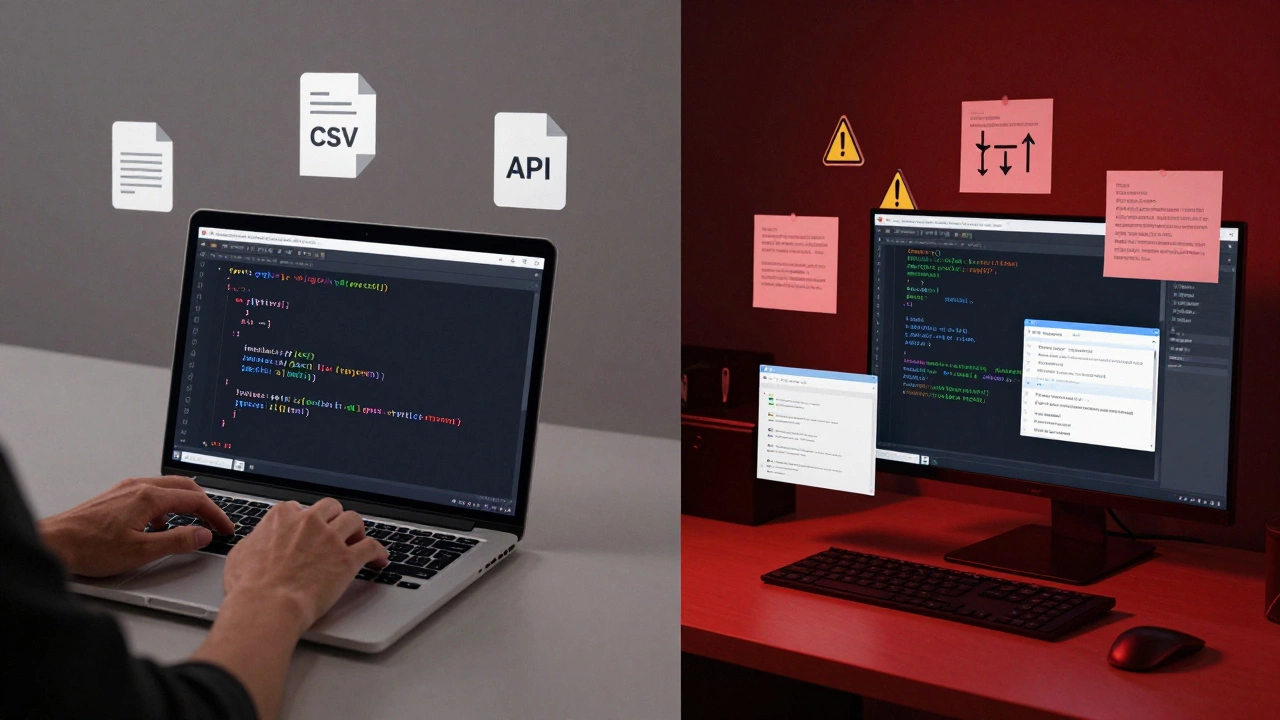
Python was built for people. Not computers. If you want to write a script that pulls data from an API, cleans it, and saves it as a CSV, you can do it in five lines. No headers. No memory management. No pointers. Just import requests, data = response.json(), and with open('file.csv', 'w') as f:. It reads like plain English. That’s not magic-it’s design.
Python handles memory for you. It guesses what you mean. If you forget to close a file? It cleans up. If you add a string to a number? It throws a clear error instead of crashing your whole program. This matters when you’re trying to build something fast, test it, and move on. Front-end developers using Python for tools like automation scripts, data visualizations, or even backend APIs with Flask don’t waste time wrestling with the language.
C++ forces you to understand every layer
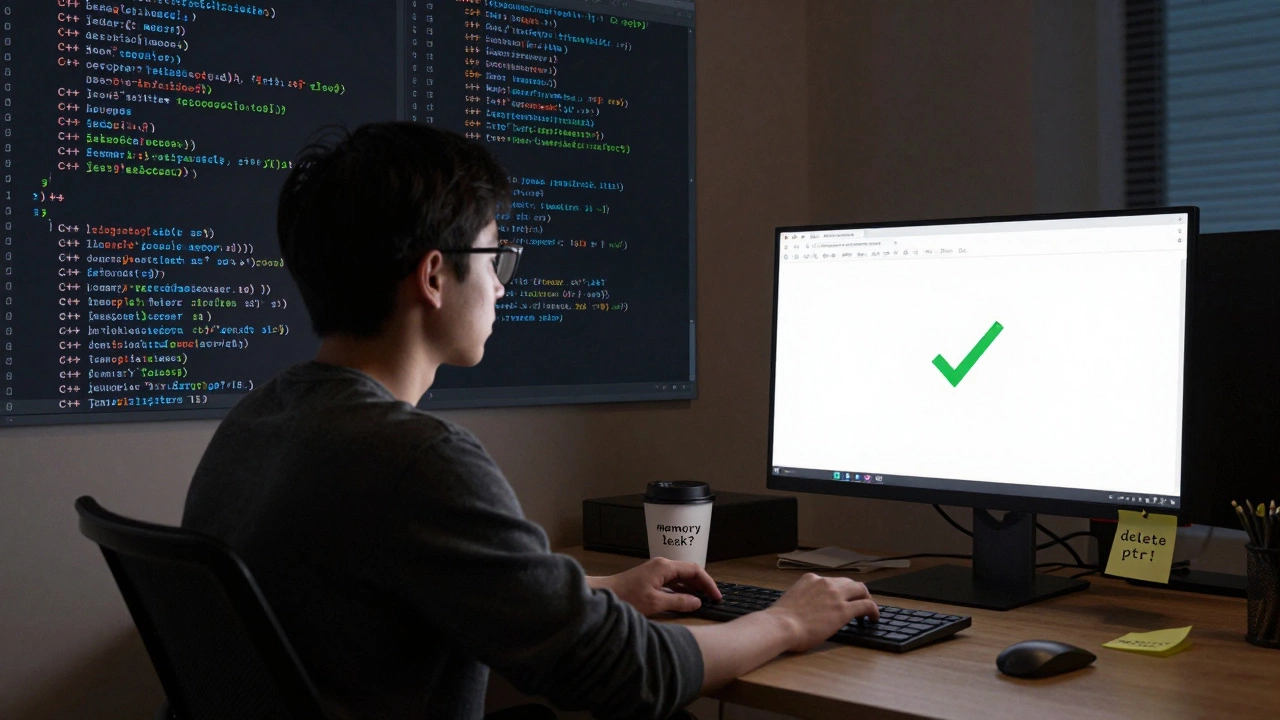
C++ doesn’t care if you’re a beginner. It assumes you know what a pointer is, how memory is laid out, and why you shouldn’t delete something twice. If you write int* ptr = new int(5);, you’re not just declaring a variable-you’re telling the computer: "Give me space here, and I promise I’ll clean it up later." If you forget delete ptr;? You’ve got a memory leak. And in a long-running web service, that leak can bring down your server.
And that’s just the start. C++ has manual memory management, templates, operator overloading, multiple inheritance, and undefined behavior that can make your program work fine on your machine but crash on someone else’s. You need to know the difference between stack and heap allocation. You need to understand why vector is safer than raw arrays. You need to know what const really means in different contexts. These aren’t optional extras-they’re daily requirements.
Front-end developers rarely need C++
Here’s the thing most beginners miss: you almost never need C++ for front-end development. Browsers run JavaScript, HTML, and CSS. Tools like React, Vue, or Svelte? All built on JavaScript. Even if you’re building a complex web app with animations, physics, or real-time data, you’re still using JavaScript-maybe with WebAssembly for performance-heavy parts.
WebAssembly lets you run C++ code in the browser. But even then, you’re not writing C++ to build the UI. You’re writing C++ to handle a 3D engine, a video codec, or a physics simulation-and then wrapping it in JavaScript so the browser can talk to it. That’s a niche use case. Most front-end devs will never touch C++ directly.
Meanwhile, Python powers the tools behind the scenes: automated testing, build scripts, data pipelines, even some server-side logic. It’s the glue. C++ is the engine. You don’t need to be a mechanic to drive a car.
Learning curves aren’t equal
Python’s learning curve is gentle. You can write useful code on day one. C++’s curve is steep and jagged. You’ll hit walls: why does this template error look like a wall of symbols? Why does this function compile but crash at runtime? Why does this pointer point to garbage?
A study from the University of Cambridge in 2023 tracked beginners learning both languages. After three months, 87% of Python learners could build a working web scraper. Only 29% of C++ learners could do the same. Why? Because Python abstracts away the complexity. C++ makes you build it yourself.
It’s not that C++ is "worse." It’s that it gives you control-over memory, over performance, over every byte. But that control comes with responsibility. And responsibility means more mental load.
When C++ actually matters for web work
There are exceptions. If you’re working on a high-performance web server (like Nginx or a custom WebSocket engine), C++ might be used. If you’re building a browser extension that needs to process huge files fast, C++ via WebAssembly could help. If you’re optimizing a rendering engine for a real-time dashboard, C++ might be the only option.
But these are rare. Most web teams hire specialists for those tasks. Front-end developers? They focus on user experience, responsiveness, accessibility, and integration. That’s where Python shines-not because it’s "better," but because it’s the right tool for the job.

It’s not about intelligence-it’s about trade-offs
Some people say C++ is harder because "you’re just not smart enough." That’s nonsense. It’s not about IQ. It’s about what you’re trying to do.
Python lets you solve problems faster. C++ lets you solve them with more control-and sometimes, more speed. But speed isn’t always what matters. A website that loads in 1.2 seconds instead of 1.0? Users won’t notice. A website that crashes because of a memory leak? They’ll leave.
For 95% of web developers, the trade-off isn’t worth it. You gain a few milliseconds of performance, but lose weeks of debugging time. You gain fine-grained control, but lose the ability to ship features quickly. And in web development, shipping fast often beats perfect code.
What should you learn?
If you’re starting out in front-end development, learn JavaScript. Then learn Python to automate your workflow, test your code, or handle data. You’ll be more productive, more confident, and less stressed.
If you’re already experienced and want to dive into performance-critical systems, then C++ makes sense. But even then, start with a clear goal: "I need to optimize this video encoder," not "I want to learn a hard language."
Don’t choose C++ because it sounds impressive. Choose it because you have a problem Python can’t solve. Otherwise, you’re just making your life harder for no reason.