

Java isn’t dead. It’s just not the shiny new thing anymore. If you’ve been scrolling through tech forums or hearing whispers in developer meetups, you might think Java is fading away-replaced by JavaScript, Python, or Rust. But that’s not the full story. Java is still running on 3 billion devices worldwide, powering 90% of Fortune 500 companies, and handling the backend of apps you use every day-from banking apps to airline booking systems. The question isn’t whether Java is dying. It’s whether it’s still relevant for developers today, especially those focused on frontend work.
Java’s role in frontend development
Let’s clear up a common confusion right away: Java doesn’t run in browsers. Not anymore. Not in any meaningful way. The last time Java applets were a thing was the early 2000s. They were slow, insecure, and blocked by every modern browser. Today, if you’re building a frontend-whether it’s a React app, a Vue interface, or a simple HTML form-you’re using JavaScript, TypeScript, or maybe WebAssembly. Java has no direct role here.
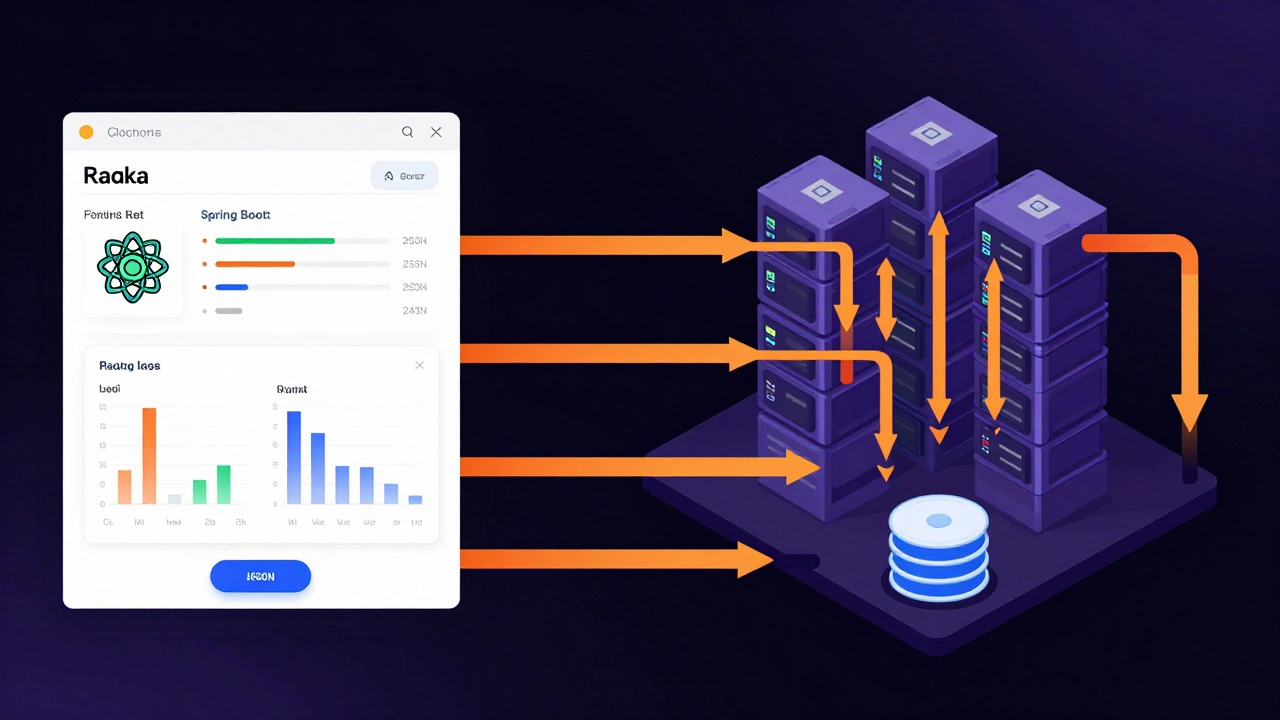
So why do people keep asking if Java is dying in frontend development? Because they’re mixing up the frontend with the full stack. Many Java developers work on backend systems that feed data to frontend apps. They write REST APIs with Spring Boot, connect to PostgreSQL databases, and handle authentication using OAuth2-all in Java. That data then gets consumed by a React frontend running in the browser. Java isn’t building the UI, but it’s the engine behind it.
What’s really changing for Java
The real shift isn’t about Java disappearing. It’s about where it’s being used. In 2010, Java was the default choice for almost every enterprise app. Today, startups reach for Node.js or Go because they’re faster to prototype with. New mobile apps lean toward Kotlin (for Android) or Swift (for iOS). Even Python is stealing ground in data-heavy backend services.
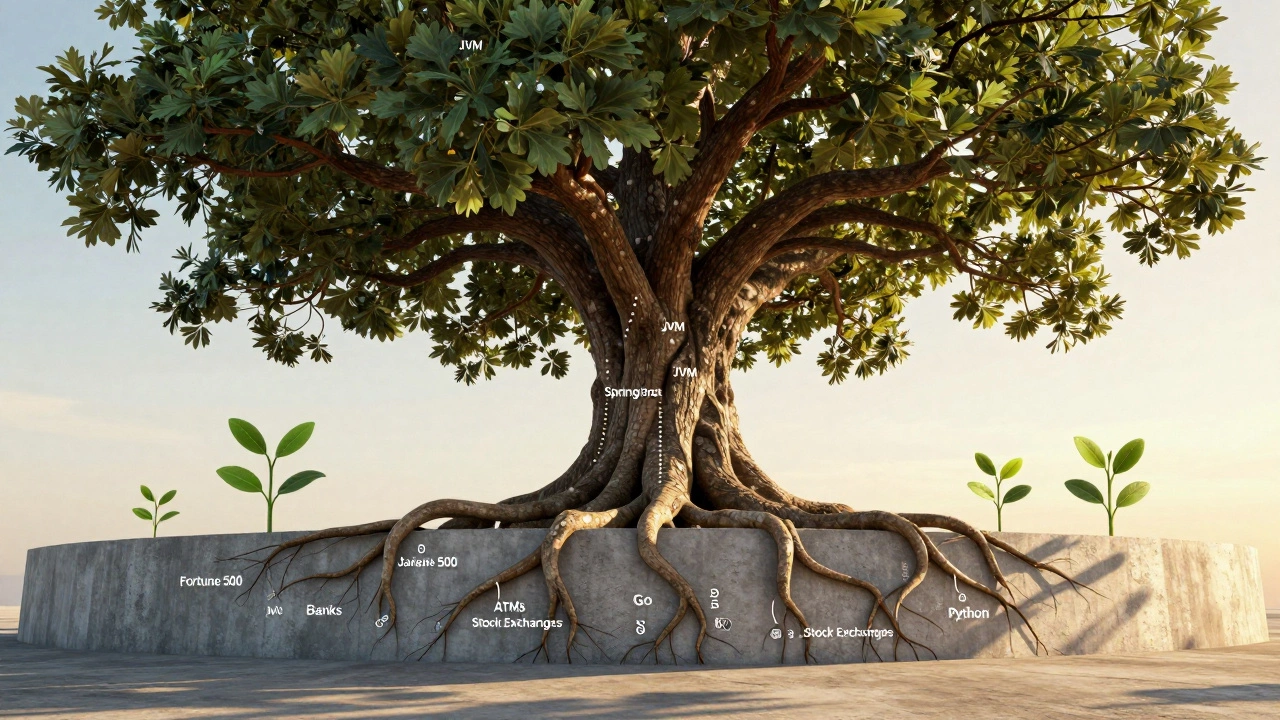
But here’s what nobody talks about: Java’s ecosystem is still unmatched. Spring Boot, Hibernate, Apache Kafka, and Maven are mature, stable, and battle-tested. Companies don’t replace them just because something new came out. Switching a banking system from Java to Go isn’t a technical decision-it’s a risk management nightmare. The cost of migration, testing, training, and downtime often outweighs the benefits.
In 2024, Java still dominates:
- Enterprise backend systems (78% of Fortune 500 use Java-based services)
- Android app backends (even though Kotlin is now preferred for Android apps themselves)
- Big data pipelines (Hadoop, Spark, and Flink are all Java-based)
- Legacy financial systems (think ATMs, stock exchanges, insurance platforms)
That’s not dying. That’s enduring.
Java vs JavaScript: The real competition
People compare Java and JavaScript like they’re rivals. They’re not. They serve different purposes. JavaScript runs in the browser. Java runs on servers, in data centers, on embedded systems. You can’t build a frontend with Java. You can’t build a high-throughput payment processor with vanilla JavaScript.
But here’s the real tension: Java developers are being asked to learn JavaScript just to talk to their frontend teams. A Java backend engineer might need to understand how to structure JSON responses so React can consume them. They might need to debug CORS errors or understand API versioning. That’s not Java’s fault-it’s the reality of full-stack development today.
Many Java devs are adapting. They’re learning TypeScript, using Postman to test their endpoints, and even dipping into React just to see how their data looks on screen. That’s not a sign of Java dying. It’s a sign of Java developers evolving.
Why Java still wins in enterprise
Think about a hospital’s patient records system. Or a national tax filing portal. Or a global logistics network. These systems don’t get rewritten every year. They’re built to last 10, 15, even 20 years. Java’s strength isn’t speed or hype-it’s reliability. The JVM (Java Virtual Machine) has been optimized for decades. Garbage collection, memory management, threading-all of it’s been refined to handle massive loads without crashing.
Java 21 (released in 2023) brought new features like virtual threads and structured concurrency, making it easier to handle thousands of simultaneous requests efficiently. That’s not something you get with every new language. Java keeps upgrading, quietly, without fanfare.
Companies don’t choose Java because it’s trendy. They choose it because it works. And when your business depends on 99.99% uptime, you don’t gamble on the latest framework.
Who should still learn Java in 2024?
If you’re just starting out and want to build websites or mobile apps, Java isn’t your best first language. Learn JavaScript for frontend, Python for scripting, or Swift/Kotlin for mobile.
But if you’re aiming for:
- Enterprise software jobs (banks, insurance, government, healthcare)
- Backend engineering roles at large tech firms
- Working with big data or distributed systems
- Staying in a company that uses legacy Java systems
Then Java is still one of the most valuable skills you can have. It’s not glamorous. It doesn’t trend on Twitter. But it pays well-median salary for Java backend developers in the UK is £62,000, and in the US, it’s $110,000.
What’s next for Java?
Java isn’t going anywhere. Oracle’s release cycle-six months per major version-keeps it modern. The community is active. The job market is still full of openings. And while new languages like Go and Rust are gaining ground in cloud-native environments, Java still holds the crown in the enterprise world.
The future of Java isn’t about competing with JavaScript on the frontend. It’s about continuing to power the invisible infrastructure that keeps the digital world running. You won’t see it in TikTok feeds or Instagram stories. But you’ll see it every time you log into your bank, book a flight, or check your insurance claim.
Java isn’t dying. It’s just working behind the scenes.
Is Java still used for Android development in 2024?
Yes, but not as the primary language. Google officially switched to Kotlin as the preferred language for Android in 2019. New Android apps are almost always built with Kotlin. However, millions of existing Android apps still run on Java code. Many companies maintain legacy Java codebases, and Java is still fully supported by Android Studio. So while you won’t start a new Android project in Java, you’ll still encounter it in the wild.
Can Java be used for frontend web development?
No, not directly. Java cannot run in modern web browsers. Java applets were discontinued over a decade ago. While tools like GWT (Google Web Toolkit) once allowed Java code to compile to JavaScript, they’re now obsolete. Today’s frontend development relies on JavaScript, TypeScript, React, Vue, or Svelte. Java’s role is strictly backend-serving data via APIs that frontend frameworks consume.
Is Java slower than JavaScript or Python?
Not in practice. Java runs on the JVM, which uses Just-In-Time (JIT) compilation to optimize code at runtime. For CPU-intensive tasks-like processing financial transactions or handling database queries-Java is often faster than Python and competitive with JavaScript (Node.js). JavaScript is faster for I/O-heavy tasks (like serving web pages), but Java wins in raw computational performance. The difference is rarely noticeable to users, but it matters at scale.
Should I learn Java if I want to be a full-stack developer?
It depends on your goals. If you want to work at a startup or build consumer apps, focus on JavaScript/TypeScript, React, and Node.js. If you’re targeting enterprise roles in finance, healthcare, or government, Java is a must. You’ll still need to learn frontend basics, but Java gives you access to high-paying backend roles with less competition than the JavaScript space. Many full-stack developers today use Java for the backend and JavaScript for the frontend-it’s a common and powerful combo.
Is Java losing popularity?
It’s plateauing, not collapsing. According to the TIOBE Index and Stack Overflow Developer Survey, Java dropped from #1 to #3 in popularity between 2015 and 2023, behind Python and JavaScript. But it’s still in the top 3. The number of Java jobs hasn’t declined-it’s just grown slower than roles in Python or JavaScript. Java’s strength isn’t in new adoption; it’s in deep, entrenched usage. Millions of lines of Java code are still being maintained and updated every day.
What’s replacing Java in new projects?
In startups and cloud-native apps, Go and Node.js are common replacements for simple APIs. Python dominates data-heavy services and AI backends. Rust is gaining traction in performance-critical systems. But none of these have replaced Java in enterprise environments. You’ll see Go used for microservices, Python for machine learning, and Java for the core transaction systems that tie everything together. It’s not replacement-it’s specialization.
Final thought: Java’s quiet dominance
Java doesn’t need to be trendy to be valuable. It doesn’t need viral memes or hype cycles. It just needs to work-reliably, securely, at scale. And for the systems that run the world’s critical infrastructure, it still does that better than almost anything else.
If you’re a frontend developer, you don’t need to learn Java. But if you’re building full-stack systems, understanding how Java powers the backend will make you a better engineer. And if you’re looking for a stable, well-paid career in software, Java isn’t a relic-it’s a roadmap.