

Web Development Learning Time Calculator
Based on industry standards: 500 hours of hands-on coding required for junior developer roles.
Your Learning Timeline
500 hours of focused practice required for job-ready skills (based on industry standards)
Estimated Time to Job Readiness
Calculating...
Projects Completed
Calculating...
(30 small projects at 45-min daily sessions)
How many hours a day should you spend learning web development? There’s no magic number that works for everyone, but there are proven patterns that help people go from zero to job-ready faster. If you’re trying to figure out whether 30 minutes is enough or if you need to grind 8 hours a day, the answer isn’t about quantity-it’s about consistency, focus, and what you do with that time.
Start Small, Stay Consistent
Most people quit web development because they try to do too much too soon. They think they need to spend 4-6 hours a day to make progress. That’s not true. You can build real skills with just 45 minutes a day, five days a week. The key isn’t marathon sessions-it’s showing up every day.
Think of it like learning to play guitar. You don’t become a guitarist by playing for 10 hours on Saturday and then ignoring the instrument the rest of the week. You become one by practicing chords for 20 minutes every day. The same applies to coding. A 45-minute daily session where you write code, fix bugs, and rebuild small projects will outperform a 5-hour binge once a week.
Studies from the University of California show that spaced repetition-learning in short, regular bursts-boosts retention by up to 50% compared to cramming. That’s why people who code for 30-60 minutes daily are more likely to land their first job than those who wait for "free time" on weekends.
What to Do in Your Daily Session
Just sitting in front of a screen for an hour won’t cut it. You need structure. Here’s what a focused 45-minute session looks like:
- 10 minutes - Review yesterday’s code. Fix bugs, refactor, or ask yourself: "Could this be cleaner?"
- 20 minutes - Learn one new concept. Use free resources like MDN Web Docs, freeCodeCamp, or The Odin Project. Don’t watch videos-do the exercises.
- 15 minutes - Build something small. A button that changes color. A form that validates input. A responsive card layout.
That’s it. No fluff. No scrolling through YouTube tutorials for 30 minutes. You’re building muscle memory, not just collecting knowledge.
After 30 days of this routine, you’ll have built 30 small projects. That’s more than most people do in three months of sporadic learning.
How Much Time Do You Really Need?
If you’re aiming to land your first junior developer job, most hiring managers expect you to have 300-500 hours of hands-on coding experience. That doesn’t mean 500 hours of watching videos. It means 500 hours of typing code, breaking things, and fixing them.
Here’s how that breaks down by schedule:
| Daily Hours | Days Per Week | Months to 500 Hours |
|---|---|---|
| 0.5 | 5 | 20 |
| 1 | 5 | 10 |
| 1.5 | 5 | 7 |
| 2 | 5 | 5 |
| 3 | 5 | 3.5 |
Notice something? You don’t need to quit your job or study full-time. Even working 1 hour a day, five days a week, gets you there in 10 months. That’s doable if you’re consistent.
What Doesn’t Work
Here are the three biggest mistakes people make:
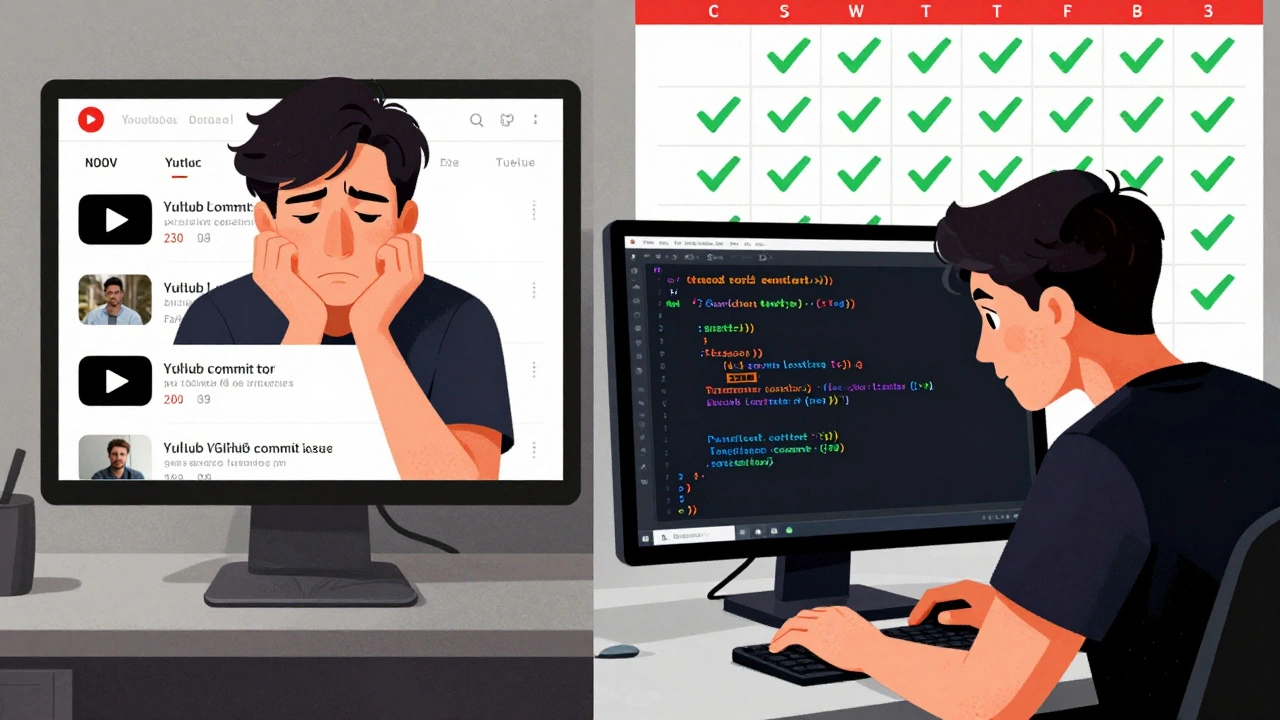
- Watching too many tutorials - You think you’re learning because you watched a 2-hour video on React. But if you didn’t write a single line of code, you didn’t learn anything.
- Switching frameworks every week - React? Vue? Svelte? Angular? Pick one. Master it. Move on later. Jumping around makes you a jack-of-all-trades and master of none.
- Waiting for "perfect" conditions - "I’ll start when I have more time." "I’ll begin after my project ends." There’s never a perfect time. Start now with what you have.
One person I know in Leeds went from zero to a junior frontend role in 8 months. He worked 9-to-5 in retail, then coded for 60 minutes every evening. No fancy bootcamp. No degree. Just daily practice, GitHub commits, and building small apps he actually used-like a grocery list app and a local event calendar.
What If You Have More Time?
If you can spare 2-3 hours a day, that’s great. But don’t waste it. Here’s how to use extra time wisely:
- Build one larger project per month (like a portfolio site, a blog, or a task manager).
- Contribute to open-source projects on GitHub. Start with tiny fixes-typos in docs, button styling.
- Join a local or online coding group. Talk about your code. Get feedback.
- Learn to use Git and GitHub like a pro. Most beginners skip this and regret it later.
Don’t just add more hours. Add more depth. More projects. More feedback. More real-world problems.
Realistic Timelines
Here’s what you can expect based on your daily commitment:
- 30 minutes/day, 5 days/week - 6-8 months to basic proficiency. You’ll be able to build simple static websites with HTML, CSS, and JavaScript.
- 1 hour/day, 5 days/week - 4-6 months to job-ready. You’ll have a portfolio with 5-8 projects, understand responsive design, and know how to use a framework like React.
- 2+ hours/day, 5 days/week - 2-3 months to entry-level readiness. You’ll be comfortable with full-stack basics, APIs, and deployment.
These aren’t promises. They’re averages from real people who stuck to a routine. The difference between someone who learns in 3 months and someone who takes 2 years? It’s not talent. It’s daily action.

Tools to Keep You on Track
You don’t need expensive apps. Here’s what works:
- GitHub - Commit every day. Even if it’s just one line. It builds a visible track record.
- Notion or Google Sheets - Track your daily hours and what you built. Seeing progress keeps you motivated.
- Focus apps - Try Forest or Focus To-Do. Block distractions during your 45-minute block.
- CodePen or Replit - Quick playgrounds to test ideas without setting up a local environment.
One developer in Manchester told me he used a simple habit tracker on his phone. Every day he coded, he tapped a green button. After 30 days, he had a streak. He didn’t want to break it. That’s all it took.
What Comes After You Start?
Once you’ve been coding daily for 3 months, you’ll start noticing changes:
- You’ll understand error messages instead of panicking.
- You’ll know where to look for answers without Googling for an hour.
- You’ll feel confident asking for help in forums.
- You’ll start thinking like a developer-breaking problems into smaller parts.
That’s when the real learning begins. You’re no longer just following tutorials. You’re solving your own problems.
Don’t wait until you "feel ready" to apply for jobs. Apply when you’ve built 3 solid projects. Most junior roles don’t expect you to know everything. They want someone who can learn, adapt, and show up consistently.
Final Answer
How many hours a day should you learn web development? Start with 45 minutes. Do it every weekday. Stick with it for 6 months. That’s enough to go from beginner to job-ready.
You don’t need to be a genius. You don’t need a degree. You don’t need to work 12-hour days. You just need to show up, code something real, and do it again tomorrow.
Is 30 minutes a day enough to learn web development?
Yes, 30 minutes a day is enough if you’re consistent and focused. Many people land their first job after 6-8 months of daily 30-minute sessions. The key isn’t the length of time-it’s doing something active every day, like writing code, fixing bugs, or building small features. Passive learning (like watching videos) won’t get you there.
Can I learn web development in 3 months?
You can reach a basic job-ready level in 3 months if you dedicate 2-3 hours a day, 5 days a week. That’s around 300-450 hours of focused practice. You’ll need to build a portfolio of 5-7 real projects, learn HTML, CSS, JavaScript, and one framework like React, and understand how to deploy code. It’s intense, but doable with discipline.
Should I learn frontend or backend first?
Start with frontend. Learn HTML, CSS, and JavaScript first. You’ll see immediate results-buttons, layouts, animations. That builds confidence. Once you’re comfortable with how websites work on the client side, move to backend basics like Node.js, APIs, and databases. Most employers expect junior developers to understand both, but starting with frontend gives you a clearer path.
Do I need a degree to get a web development job?
No, you don’t need a degree. Most companies hiring junior developers care more about your portfolio, GitHub activity, and problem-solving skills than your education. I’ve seen people with no college background land jobs after building 6 solid projects and consistently contributing to open-source. Your code speaks louder than your diploma.
What’s the most important skill in web development?
The most important skill is problem-solving. Knowing syntax matters, but being able to break down a bug, read error messages, search for solutions, and test fixes is what separates beginners from developers. This skill grows with practice-not from memorizing tutorials. The more you code, the better you get at figuring things out on your own.
How do I stay motivated when learning feels slow?
Track your progress. Keep a simple log of what you built each day. Even small wins-like fixing a CSS bug or making a button work-count. Celebrate them. Join a community, even a small one. Talking to others who are struggling too helps. And remember: every expert was once a beginner who showed up every day, even when they didn’t feel like it.
Web development isn’t about how fast you learn. It’s about how long you keep going. Start small. Stay steady. Build something real every day.